Download the PHP package fleetbase/fleetops-api without Composer
On this page you can find all versions of the php package fleetbase/fleetops-api. It is possible to download/install these versions without Composer. Possible dependencies are resolved automatically.
Download fleetbase/fleetops-api
More information about fleetbase/fleetops-api
Files in fleetbase/fleetops-api
Package fleetops-api
Short Description Fleet & Transport Management Extension for Fleetbase
License AGPL-3.0-or-later
FAQ
Example:

In general, it is recommended to use always a project to download your libraries. In an application normally there is more than one library needed.

- Some hosting areas are not accessible by a terminal or SSH. Then it is not possible to use Composer.
- To use Composer is sometimes complicated. Especially for beginners.
- Composer needs much resources. Sometimes they are not available on a simple webspace.
- If you are using private repositories you don't need to share your credentials. You can set up everything on our site and then you provide a simple download link to your team member.
- Simplify your Composer build process. Use our own command line tool to download the vendor folder as binary. This makes your build process faster and you don't need to expose your credentials for private repositories.
Informations about the package fleetops-api

Open-source fleet, dispatch, transport management, and real-time logistics operations for Fleetbase.







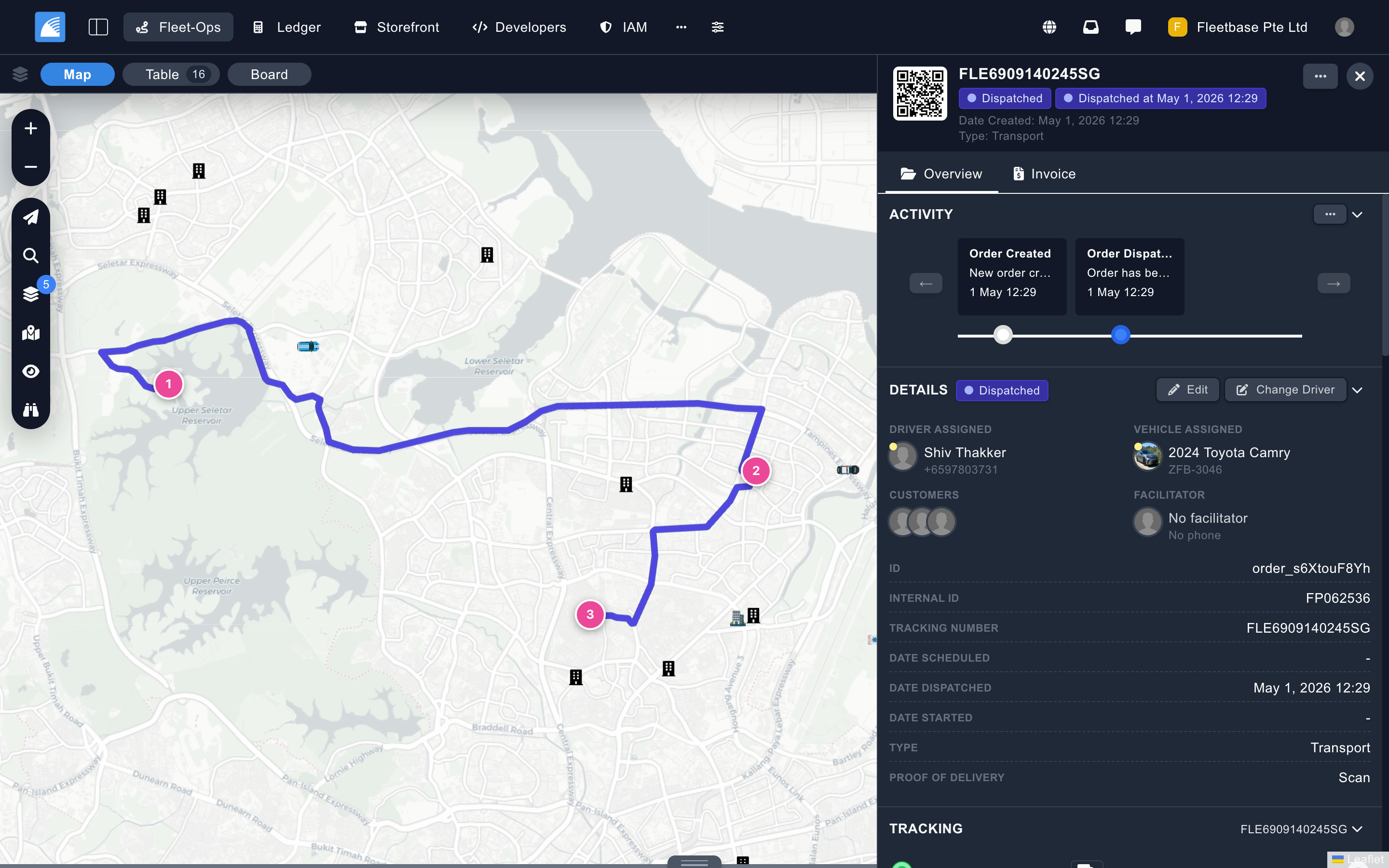
What is Fleet-Ops?
Fleet-Ops is the core logistics and fleet management extension for the Fleetbase platform. It gives operations teams a dispatch console for managing orders, drivers, vehicles, fleets, service areas, live maps, route execution, analytics, maintenance, and connected telematics.
Fleet-Ops ships as two packages:
| Package | Purpose |
|---|---|
@fleetbase/fleetops-engine |
Ember Engine/Add-on that powers the Fleet-Ops console UI. |
fleetbase/fleetops-api |
Laravel/PHP package that provides the Fleet-Ops API, models, jobs, events, and integrations. |
Fleet-Ops is included with Fleetbase Cloud and self-hosted Fleetbase installations. For product concepts, workflows, and setup guides, start with the Fleet-Ops documentation.
Features
Operations
- Create, import, schedule, dispatch, start, cancel, and complete delivery orders.
- Manage multi-waypoint routes, payloads, entities, labels, order metadata, notes, comments, files, and proofs.
- Track live order progress with ETAs, route overlays, driver pings, activity timelines, and configurable status flows.
- Configure custom order types, activity flows, entity fields, proof requirements, and service-rate rules.
- Run orchestration workflows for order allocation, driver assignment, vehicle capacity, and route sequencing.
- Plan work with the scheduler, fleet schedule, service quotes, routes, manifests, and manifest stops.
Live Map
- View live drivers, vehicles, active orders, routes, places, service areas, zones, and geofences.
- Filter and inspect operational layers with Fleet-Ops map controls and drawer panels.
- Support Leaflet-based and Google-based map experiences through Fleetbase map settings.
- Capture positions, replay movement, track vehicles and drivers, and surface geofence events.
Fleet Management
- Manage drivers, vehicles, fleets, places, contacts, customers, vendors, and integrated vendors.
- Assign drivers and vehicles to fleets, vendors, and orders.
- Track driver schedules, availability, positions, active shifts, and hours-of-service status.
- Track vehicle status, devices, positions, equipment, schedules, work orders, and maintenance history.
- Manage issues, fuel reports, imports, exports, bulk actions, and custom resource fields.
Maintenance
- Define preventive maintenance schedules and calendar feeds.
- Manage work orders, maintenance records, line items, equipment, parts, and warranties.
- Send work orders, trigger schedule runs, pause and resume schedules, and review maintenance history.
Connectivity
- Connect telematics providers, devices, sensors, events, and tracking data.
- Discover and link telematics devices, test provider credentials, and receive telematics webhooks.
- Use Fleet-Ops tracking providers for calculated, OSRM, and Google Routes-backed route intelligence.
Analytics and Dashboards
- Use Fleet-Ops KPI widgets for earnings, average order value, distance, active orders, online drivers, and open issues.
- Review analytics for operations pulse, live fleet, revenue trends, order status volume, on-time delivery, top drivers, fuel efficiency, issues, maintenance, and geofence violations.
- Create and view reports from the Fleet-Ops analytics workspace.
Settings and Extensions
- Configure Navigator app onboarding, routing, tracking, map providers, notifications, scheduling, payments, orchestrator settings, custom fields, and avatars.
- Expose Fleet-Ops order tracking on the Fleetbase login surface.
- Integrate Fleet-Ops entities into other Fleetbase extensions through registered components and virtual detail tabs.
Architecture
Fleet-Ops follows the Fleetbase extension architecture: an Ember Engine for the console interface and a Laravel package for API and backend capabilities.
Core frontend dependencies include Ember Octane, Ember Engines, Fleetbase Ember Core, Fleetbase UI, Fleet-Ops Data, Leaflet, Leaflet Draw, Turf, JointJS, and Stripe Connect. Core backend capabilities are provided by Laravel, Fleetbase Core API, Fleet-Ops models/controllers, orchestration engines, tracking providers, analytics, notifications, jobs, and telematics integrations.
Getting Started
Fleet-Ops comes pre-installed with Fleetbase Cloud and standard self-hosted Fleetbase installations. If you are setting up the Fleetbase platform itself, use the Fleetbase documentation:
When developing Fleet-Ops from source, install both frontend and backend dependencies:
Link Fleet-Ops into Fleetbase
When working from the Fleetbase monorepo, use the Fleetbase package linker to connect this local package to the running Console and API applications. From the Fleetbase repository root:
This links the local Fleet-Ops Ember engine and Laravel package so Console and API use your source checkout instead of the published packages. See the Fleetbase development setup guide for the full package-linking workflow, Docker setup, Octane reload notes, and frontend hot-reload options.
Link Fleet-Ops Data
Fleet-Ops also depends on the shared @fleetbase/fleetops-data package. That package contains Fleet-Ops Ember Data models, adapters, and serializers, and can be reused by other Fleetbase modules that need to read or write Fleet-Ops resources without duplicating data-layer definitions.
If you are changing shared Fleet-Ops data models or consuming them from another extension, link fleetops-data through the root Console workspace:
For broader Fleet-Ops frontend work, you may also link the common shared Ember packages used by Fleetbase:
Development
Start the Ember Engine in development mode:
Build the production frontend bundle:
Run frontend linting:
Run backend linting:
Testing
Run the Ember/QUnit test suite:
Run the full frontend check suite:
Run the backend test suite:
Run backend checks individually:
Documentation
Contributing
Contributions are welcome. Please read CONTRIBUTING.md before opening a pull request.
Useful project files:
- package.json for frontend scripts and package metadata.
- composer.json for backend scripts and package metadata.
- extension.json for Fleetbase extension metadata.
License
Fleet-Ops is open-source software licensed under the GNU Affero General Public License v3.0 or later.
All versions of fleetops-api with dependencies

barryvdh/laravel-dompdf Version ^3.1
brick/geo Version 0.7.2
cknow/laravel-money Version ^7.1
fleetbase/core-api Version *
geocoder-php/google-maps-places-provider Version ^1.4
giggsey/libphonenumber-for-php Version ^8.13
league/geotools Version ^1.1.0
milon/barcode Version ^10.0
php-http/guzzle7-adapter Version ^1.0
php-units-of-measure/php-units-of-measure Version ^2.2
psr/http-factory-implementation Version *
rlanvin/php-rrule Version ^2.6
toin0u/geocoder-laravel Version ^4.4
webit/eval-math Version ^1.0
spatie/icalendar-generator Version ^2.8