Download the PHP package everdreamsoft/sandra without Composer
On this page you can find all versions of the php package everdreamsoft/sandra. It is possible to download/install these versions without Composer. Possible dependencies are resolved automatically.
FAQ
Example:

In general, it is recommended to use always a project to download your libraries. In an application normally there is more than one library needed.

- Some hosting areas are not accessible by a terminal or SSH. Then it is not possible to use Composer.
- To use Composer is sometimes complicated. Especially for beginners.
- Composer needs much resources. Sometimes they are not available on a simple webspace.
- If you are using private repositories you don't need to share your credentials. You can set up everything on our site and then you provide a simple download link to your team member.
- Simplify your Composer build process. Use our own command line tool to download the vendor folder as binary. This makes your build process faster and you don't need to expose your credentials for private repositories.
Informations about the package sandra
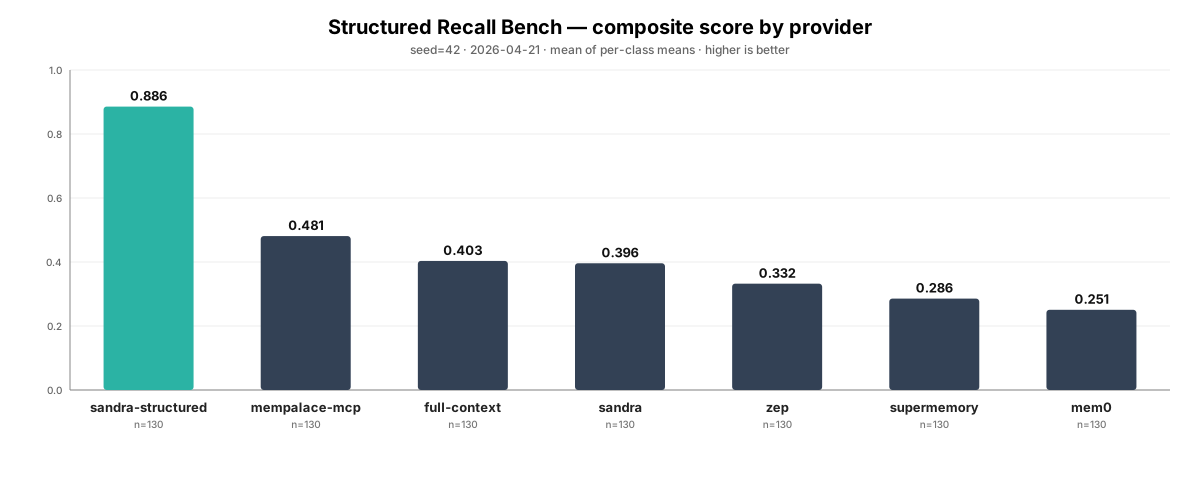
Self-hostable graph + vector memory. Native MCP. 0.89 on Structured Recall Bench, where vector stores cluster between 0.25 and 0.48.


Every AI agent forgets. Vector memory finds similar text but can't enumerate or relate. Classical graph DBs use free-form labels that no LLM can read. SaaS memory ships your data to someone else's servers.
Sandra is a self-hostable graph + vector memory layer where every concept (verb, label, category) has a unique ID and a human-readable name. Your agents read, write, and reason over a shared lexicon. Every relationship is an explicit synapse you can trace. Exposed natively via MCP, so any LLM that can call a tool can use it.
Install
That's it! your agent now has persistent memory across sessions, projects, machines, and clients (Claude, GPT, Gemini, Llama, Mistral...).
Other clients · semantic search · claude.ai web (HTTPS) · from source
Cursor, Cline, Continue, Zed, OpenAI Agents SDK, custom clients: point your client's MCP server config at `http://127.0.0.1:8090/mcp`. From source (PHP 8+, MySQL, composer): see [Install Sandra](https://sandraeds.everdreamsoft.com/getting-started-installation). Set `SANDRA_AUTH_TOKEN` in `.env` before exposing the trycloudflare URL, it is public.Full setup, OAuth 2.1/PKCE, auth tokens: Install Sandra. MCP tool reference: mcp overview. Live quickstart and demos: sandraeds.everdreamsoft.com. Questions? Join the Discord.
What recall feels like
Memory lives in your Sandra instance, not in any model's context window. Switch models, switch clients, switch machines: the memory stays.
The next generation of software will be written by agents that need memory like ours.
Why Sandra
Current market solutions are not able to retrieve all the data correctly, so it is impossible to trust agents with precise tasks. Here is how they compare.
| Approach | Example | SRB composite | Trade-off |
|---|---|---|---|
| Vector retrieval | Mem0, Zep, Supermemory | 0.25 to 0.33 | Finds similar text, can't enumerate or relate |
| Verbatim retrieval | MemPalace | 0.48 | A static memory palace, no associative recall |
| Classical graph DB | Neo4j, TigerGraph | (no provider) | Free-form labels, unreadable for LLMs |
| Sandra + planner | this repo | 0.89 | Graph + vector + shared LLM-readable lexicon |
130 deterministic questions, no LLM-judge, raw responses archived. Full design rationale: Sandra memory design.
Sandra is for you if you want your agent to remember across sessions and machines, you want to own the data, you build with multiple LLMs, or you need explicit relationships instead of fuzzy similarity. Skip Sandra if you need a transactional database (use Postgres), pure vector retrieval at massive scale (use a dedicated vector store), or zero infrastructure (use a hosted service).
How memory works
Four primitives, mapped to what neurons do.
- Concept - a stable, named ID; the neuron (
likes,works_at,user). - Triplet - a
(subject, verb, target)link; the synapse. - Entity - a typed cluster of refs grouped by a factory; a named region.
- Factory - the schema for an entity cluster (
person,product,task).
DB analog: concepts are words, entities are rows, factories are tables, triplets are sentences.
Encounter Alice, Sandra activates that node and follows every synapse outward in one query, spreading activation (Collins & Loftus, 1975), the mechanism behind associative human recall. Because every concept is a stable, named ID, an LLM can call sandra_list_concepts and read the entire vocabulary. No schema file, no documentation needed.
One concept, many implementations
A concept's identity is stable, but the attributes attached to it can vary by source. Concept(user) keeps a single ID across every system that talks about it:
This is what philosophers since Frege have called invariance of reference under variation of sense. What programmers call polymorphism. What your agents need so they can answer "show me everything we know about this user" without lying, conflating, or losing source attribution.
Building a multi-agent system? Every agent is itself an entity in the same graph it reads from. Pattern + comparison with CrewAI / LangGraph / OpenAI Assistants in Guides - multi-agent.
Beyond agent memory
Same primitives also handle:
- Personal knowledge management: Stash articles, strategy notes, ideas as typed entities. Ask: "Give me the 10 most-engaging emotional tweets I posted; suggest an eleventh."
- Relationship CRM: Track who covered you, who knows whom, who said what. "Which journalists wrote about us this year? Who at TechCrunch?"
- Headless CMS for LLM-driven apps: Expose Sandra over the REST API + a thin UI; let agents update content from natural language. "Change the price of the Geneva listing to 350."
- Lightweight analytics: Log who-viewed-what as triplets, query later via the same MCP tools. "Which cards got the most attention from European visitors last week?"
Switching frame is a query, not a migration.
Building on Sandra
- PHP SDK:
composer require everdreamsoft/sandraphp sdk - REST API: language-agnostic sdk rest api
- Python and TypeScript SDKs: coming
Documentation
| Guide | What it covers |
|---|---|
| Install Sandra | Sandra + MCP server + your MCP client |
| mcp overview | MCP server reference: tools, configuration, custom tools |
| sdk rest api | REST API and PHP SDK |
agent-memory-design.md |
Why Sandra is shaped the way it is |
Community & Status
Join the conversation on Discord. Live quickstart at sandraeds.everdreamsoft.com.
Used in production at EverdreamSoft, notably in Spells of Genesis. MCP layer and OAuth 2.1/PKCE auth running in production.
MIT license: see CONTRIBUTING.md.
All versions of sandra with dependencies

ext-json Version *