Libraries tagged by app_details
noerd/noerd
2496 Downloads
YAML-driven Livewire framework for multi-tenant Laravel applications: generic list, detail and page components, modals, themes, tenant apps and install/update tooling.
revkeen/sdk-php
1831 Downloads
RevKeen is a fintech-grade API for payments, subscriptions, invoices, and billing. The canonical production MCP server is available at `https://mcp.revkeen.com/mcp`. **API Version:** `2026-05-01` — Pin with the `RevKeen-Version` header. **Quick Links:** [Full Documentation](https://docs.revkeen.com) | [Authentication](https://docs.revkeen.com/authentication) | [OAuth](https://docs.revkeen.com/oauth) | [SDKs](https://docs.revkeen.com/sdks) | [Webhooks](#webhooks) | [MCP Guide](https://docs.revkeen.com/mcp) ## Authentication Two authentication methods are supported: ### API Keys (recommended for server-to-server REST API integrations) Send your API key in the `x-api-key` header. Get keys from the [Dashboard](https://app.revkeen.com/settings/api-keys). Use `rk_sandbox_*` for test mode and `rk_live_*` for production. ### OAuth 2.1 (recommended for MCP and third-party integrations) Use OAuth 2.1 with PKCE for authorization code flow or client credentials for server-to-server. Tokens are sent via `Authorization: Bearer rk_oauth_*`. See the [OAuth guide](https://docs.revkeen.com/oauth) for setup. - **Authorization Code + PKCE** — user-facing integrations, MCP hosts - **Client Credentials** — server-to-server, automated workflows - **Dynamic Client Registration** — MCP hosts that auto-register ## MCP Integration RevKeen's canonical production MCP server is `https://mcp.revkeen.com/mcp` using Streamable HTTP and OAuth 2.1 bearer tokens. - **Customer launch surface** — read-first customer v1 tools with least-privilege scopes - **Host setup guide** — see the [MCP guide](https://docs.revkeen.com/mcp) for ChatGPT, Claude, and compatible MCP hosts ## API Key Scopes Scopes follow `{resource}:{action}` format (e.g., `invoices:read`, `customers:*`). See [full scope reference](https://docs.revkeen.com/authentication#scopes). | Category | Scope | Description | |----------|-------|-------------| | **Payments & Checkout** | `checkout:read` | View checkout session details | | | `checkout:write` | Create and manage checkout sessions | | | `cart:read` | View cart session details (REV-3511) | | | `cart:write` | Create and mutate cart sessions, line items, add-ons (REV-3511) | | | `payment_links:read` | View payment links | | | `payment_links:write` | Create and manage payment links | | | `charges:read` | View one-time charges | | | `charges:write` | Create one-time charges for customers | | | `payments:read` | View payment details | | | `payments:write` | Capture or void payments | | | `payment_intents:read` | View payment intent details | | | `payment_intents:write` | Create, confirm, capture, and cancel payment intents | | | `setup_intents:read` | View setup intent details | | | `setup_intents:write` | Create, confirm, and cancel setup intents | | | `payment_methods:read` | View saved payment methods | | | `payment_methods:write` | Attach and detach payment methods | | **Billing** | `invoices:read` | View invoices | | | `invoices:write` | Create, update, and manage invoices | | | `subscriptions:read` | View subscriptions | | | `subscriptions:write` | Create, update, pause, and cancel subscriptions | | | `subscription_schedules:read` | View subscription schedule details | | | `subscription_schedules:write` | Create, update, cancel, and release subscription schedules | | | `orders:read` | View orders | | | `orders:write` | Create and manage orders | | | `credit_notes:read` | View credit notes | | | `credit_notes:write` | Create and void credit notes | | **Products & Pricing** | `products:read` | View product catalog | | | `products:write` | Create and update products | | | `prices:read` | View pricing information | | | `prices:write` | Create and update prices | | | `discounts:read` | View discount codes | | | `discounts:write` | Create and manage discount codes | | | `tax_rates:read` | View tax rate configurations | | | `tax_rates:write` | Configure tax rates | | **Usage & Metering** | `meters:read` | View meter configurations | | | `meters:write` | Create and update meters | | | `usage:read` | View usage events and balances | | | `usage:write` | Ingest usage events | | **Customers** | `customers:read` | View customer information | | | `customers:write` | Create and update customers | | | `entitlements:read` | View customer entitlements / feature access | | | `entitlements:write` | Grant and revoke customer entitlements | | | `businesses:read` | View business entities | | | `businesses:write` | Manage business entities | | **Money Movement** | `refunds:read` | View refund details | | | `refunds:write` | Issue refunds | | | `voids:read` | View voided transactions | | | `voids:write` | Void unsettled transactions | | | `disputes:read` | View chargebacks and disputes | | | `disputes:write` | Respond to disputes | | | `payouts:read` | View payout and settlement data | | **Direct Debit** | `mandates:read` | View Direct Debit mandates and collection status | | | `mandates:write` | Create, suspend, reinstate, and cancel Direct Debit mandates | | **Terminal** | `terminal:read` | View terminal devices and card-present payments | | | `terminal:write` | Initiate, cancel, refund, and void terminal payments | | **Data Exchange** | `exports:read` | View and download data exports | | | `exports:write` | Create data exports | | | `imports:read` | View import status and history | | | `imports:write` | Upload and run data imports | | **Analytics & Reporting** | `analytics:read` | View analytics and reports | | | `finance:read` | View financial reports | | **Communication** | `comms:read` | View SMS and email delivery logs | | | `comms:write` | Send SMS, email, and WhatsApp messages | | | `automations:read` | View automations, runs, approvals, and traces | | | `automations:write` | Create automations and trigger runs | | **Integrations** | `apps:read` | View connected applications | | | `apps:write` | Manage app connections | | | `webhooks:read` | View webhook endpoints | | | `webhooks:write` | Manage webhook endpoints | | | `integrations:read` | View integration status and sync logs | | | `integrations:write` | Activate, configure, and sync integrations | | | `events:read` | View webhook event logs | | | `events:write` | Resend and test webhook events | | | `sync:read` | View sync watermarks and state | | | `sync:write` | Update sync watermarks | ## Environments | Environment | Base URL | API Key Prefix | |-------------|----------|----------------| | **Staging** | `https://staging-api.revkeen.com/v2` | `rk_sandbox_*` | | **Production** | `https://api.revkeen.com/v2` | `rk_live_*` | ## Idempotency Include `Idempotency-Key` header (UUID) on mutation requests. Keys are valid for 24 hours. ## Rate Limits | Plan | Requests/min | Burst | |------|-------------|-------| | **Staging** | 100 | 200 | | **Production** | 1000 | 2000 | | **Enterprise** | Custom | Custom |
sendpost/sendpost-php-sdk
1437 Downloads
# Introduction > ### 📌 API versioning & the v1 response contract > > This reference documents the **v1 response contract** — the stable, camelCase > response shape that SendPost commits to. This is the shape you should build against. > > **During the current deprecation window**, requests authenticated with an account > or sub-account API key receive the **legacy** response shape by default, so existing > integrations keep working unchanged. To receive the documented v1 shape today, send: > > ``` > X-SendPost-Public-Contract: v1 > ``` > > **How to tell which shape you got.** Every public response echoes the applied > contract in the `X-SendPost-Public-Contract` response header. While the legacy > shape is being served, responses also carry standard deprecation signals: > `Deprecation: true`, a `Sunset` header with the exact cut-over date, and a > `Link: ; rel="deprecation"` header pointing at the migration guide. **Read the > `Sunset` header for the authoritative end date** rather than hardcoding one. > > **After the sunset date**, v1 becomes the default and the legacy shape is no longer > served. New integrations should send `X-SendPost-Public-Contract: v1` now and rely on > the shapes in this reference. SendPost provides email API and SMTP relay which can be used not just to send & measure but also alert & optimised email sending. You can use SendPost to: * Send personalised emails to multiple recipients using email API * Track opens and clicks * Analyse statistics around open, clicks, bounce, unsubscribe and spam At and advanced level you can use it to: * Manage multiple sub-accounts which may map to your promotional or transactional sending, multiple product lines or multiple customers * Classify your emails using groups for better analysis * Analyse and fix email sending at sub-account level, IP Pool level or group level * Have automated alerts to notify disruptions regarding email sending * Manage different dedicated IP Pools so to better control your email sending * Automatically know when IP or domain is blacklisted or sender score is down * Leverage pro deliverability tools to get significantly better email deliverability & inboxing [](https://god.gw.postman.com/run-collection/33476323-e6dbd27f-c4a7-4d49-bcac-94b0611b938b?action=collection%2Ffork&source=rip_markdown&collection-url=entityId%3D33476323-e6dbd27f-c4a7-4d49-bcac-94b0611b938b%26entityType%3Dcollection%26workspaceId%3D6b1e4f65-96a9-4136-9512-6266c852517e) # Overview ## REST API SendPost API is built on REST API principles. Authenticated users can interact with any of the API endpoints to perform: * **GET**- to get a resource * **POST** - to create a resource * **PUT** - to update an existing resource * **DELETE** - to delete a resource The API endpoint for all API calls is: https://api.sendpost.io/api/v1 Some conventions that have been followed in the API design overall are following: * All resources have either /api/v1/subaccount or /api/v1/account in their API call resource path based on who is authorised for the resource. All API calls with path /api/v1/subaccount use X-SubAccount-ApiKey in their request header. Likewise all API calls with path /api/v1/account use X-Account-ApiKey in their request header. * All resource endpoints end with singular name and not plural. So we have domain instead of domains for domain resource endpoint. Likewise we have sender instead of senders for sender resource endpoint. * Body submitted for POST / PUT API calls as well as JSON response from SendPost API follow camelcase convention * All timestamps returned in response (created or submittedAt response fields) are UNIX nano epoch timestamp. All resources have either /api/v1/subaccount or /api/v1/account in their API call resource path based on who is authorised for the resource. All API calls with path /api/v1/subaccount use X-SubAccount-ApiKey in their request header. Likewise all API calls with path /api/v1/account use X-Account-ApiKey in their request header. SendPost uses conventional HTTP response codes to indicate the success or failure of an API request. * Codes in the 2xx range indicate success. * Codes in the 4xx range indicate an error owing due to unauthorize access, incorrect request parameters or body etc. * Code in the 5xx range indicate an eror with SendPost's servers ( internal service issue or maintenance ) SendPost all responses return created in UNIX nano epoch timestamp. ## Authentication SendPost uses API keys for authentication. You can register a new SendPost API key at our [developer portal](https://app.sendpost.io/register). SendPost expects the API key to be included in all API requests to the server in a header that looks like the following: `X-SubAccount-ApiKey: AHEZEP8192SEGH` This API key is used for all Sub-Account level operations such as: * Sending emails * Retrieving stats regarding open, click, bounce, unsubscribe and spam * Uploading suppressions list * Verifying sending domains and more In addition to X-SubAccount-ApiKey you also have another API Key X-Account-APIKey which is used for Account level operations such as : * Creating and managing sub-accounts * Allocating IPs for your account * Getting overall billing and usage information * Email List validation * Creating and managing alerts and more You must look at individual API reference page to look at whether X-SubAccount-ApiKey is required or X-Account-ApiKey In case an incorrect API Key header is specified or if it is missed you will get HTTP Response 401 ( Unauthorized ) response from SendPost. ## HTTP Response Headers Code | Reason | Details ---------------| -----------------------| ----------- 200 | Success | Everything went well 401 | Unauthorized | Incorrect or missing API header either X-SubAccount-ApiKey or X-Account-ApiKey 403 | Forbidden | Typically sent when resource with same name or details already exist 406 | Missing resource id | Resource id specified is either missing or doesn't exist 422 | Unprocessable entity | Request body is not in proper format 500 | Internal server error | Some error happened at SendPost while processing API request 503 | Service Unavailable | SendPost is offline for maintenance. Please try again later # API SDKs We have native SendPost SDKs in the following programming languages. You can integrate with them or create your own SDK with our API specification. In case you need any assistance with respect to API then do reachout to our team from website chat or email us at **[email protected]** * [PHP](https://github.com/sendpost/sendpost_php_sdk) * [Javascript](https://github.com/sendpost/sendpost_javascript_sdk) * [Ruby](https://github.com/sendpost/sendpost_ruby_sdk) * [Python](https://github.com/sendpost/sendpost_python_sdk) * [Golang](https://github.com/sendpost/sendpost_go_sdk) # API Reference SendX REST API can be broken down into two major sub-sections: * Sub-Account * Account Sub-Account API operations enable common email sending API use-cases like sending bulk email, adding new domains or senders for email sending programmatically, retrieving stats, adding suppressions etc. All Sub-Account API operations need to pass X-SubAccount-ApiKey header with every API call. The Account API operations allow users to manage multiple sub-accounts and manage IPs. A single parent SendPost account can have 100's of sub-accounts. You may want to create sub-accounts for different products your company is running or to segregate types of emails or for managing email sending across multiple customers of yours. # SMTP Reference Simple Mail Transfer Protocol (SMTP) is a quick and easy way to send email from one server to another. SendPost provides an SMTP service that allows you to deliver your email via our servers instead of your own client or server. This means you can count on SendPost's delivery at scale for your SMTP needs. ## Integrating SMTP 1. Get the SMTP `username` and `password` from your SendPost account. 2. Set the server host in your email client or application to `smtp.sendpost.io`. This setting is sometimes referred to as the external SMTP server or the SMTP relay. 3. Set the `username` and `password`. 4. Set the port to `587` (or as specified below). ## SMTP Ports - For an unencrypted or a TLS connection, use port `25`, `2525` or `587`. - For a SSL connection, use port `465` - Check your firewall and network to ensure they're not blocking any of our SMTP Endpoints. SendPost supports STARTTLS for establishing a TLS-encrypted connection. STARTTLS is a means of upgrading an unencrypted connection to an encrypted connection. There are versions of STARTTLS for a variety of protocols; the SMTP version is defined in [RFC 3207](https://www.ietf.org/rfc/rfc3207.txt). To set up a STARTTLS connection, the SMTP client connects to the SendPost SMTP endpoint `smtp.sendpost.io` on port 25, 587, or 2525, issues an EHLO command, and waits for the server to announce that it supports the STARTTLS SMTP extension. The client then issues the STARTTLS command, initiating TLS negotiation. When negotiation is complete, the client issues an EHLO command over the new encrypted connection, and the SMTP session proceeds normally. If you are unsure which port to use, a TLS connection on port 587 is typically recommended. ## Sending email from your application ```javascript "use strict"; const nodemailer = require("nodemailer"); async function main() { // create reusable transporter object using the default SMTP transport let transporter = nodemailer.createTransport({ host: "smtp.sendpost.io", port: 587, secure: false, // true for 465, false for other ports auth: { user: "" , // generated ethereal user pass: "", // generated ethereal password }, requireTLS: true, debug: true, logger: true, }); // send mail with defined transport object try { let info = await transporter.sendMail({ from: '[email protected]', to: '[email protected]', subject: 'Test Email Subject', html: 'Hello Geeks!!!', }); console.log("Message sent: %s", info.messageId); } catch (e) { console.log(e) } } main().catch(console.error); ``` For PHP ```php
briqpay/php-sdk
12200 Downloads
This is the API documentation for Briqpay. You can find out more about us and our offering at our website [https://briqpay.com](https://briqpay.com) In order to get credentials to the playgrund API Please register at [https://app.briqpay.com](https://app.briqpay.com) # Introduction Briqpay Checkout is an inline checkout solution for your b2b ecommerce. Briqpay Checkout gives you the flexibility of controlling your payment methods and credit rules while optimizing the UX for your customers # SDKs Briqpay offers standard SDKs to PHP and .NET based on these swagger definitions. You can download them respively or use our swagger defintitions to codegen your own versions. #### For .NET `` Install-Package Briqpay `` #### For PHP `` composer require briqpay/php-sdk `` # Standard use-case As a first step of integration you will need to create a checkout session. \n\nIn this session you provide Briqpay with the basic information necessary. In the response from briqpay you will recieve a htmlsnippet that is to be inserted into your frontend. The snippet provided by briqpay will render an iframe where the user will complete the purchase. Once completed, briqpay will redirect the customer to a confirmation page that you have defined. 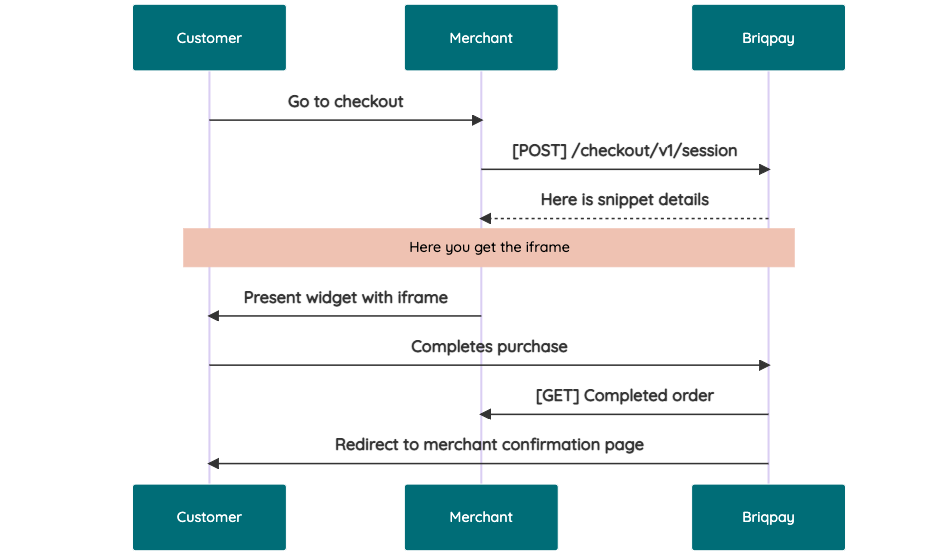 # JavaScript SDK The first step of integration is to add our JS to your site just before closing the ```` tag. This ensures that our JS library is avaliable to load the checkout. ```` Briqpay offers a few methods avaliable through our Javascript SDK. The library is added by our iframe and is avalable on ``window._briqpay`` If you offer the posibility to update the cart or order amonts on the checkout page, the JS library will help you. If your store charges the customer different costs and fees depening on their shipping location, you can listen to the ``addressupdate``event in order to re-calculate the total cost. ```javascript window._briqpay.subscribe('addressupdate', function (data) { console.log(data) }) ``` If your frontend needs to perform an action whe the signup has completed, listen to the ``signup_finalized`` event. ```javascript window._briqpay.subscribe('signup_finalized', function (status) { // redirect or handle status 'success' / 'failure' }) ``` If you allow customers to change the total cart value, you can utilise the JS library to suspend the iframe while you perform a backen update call towards our services. As described below: 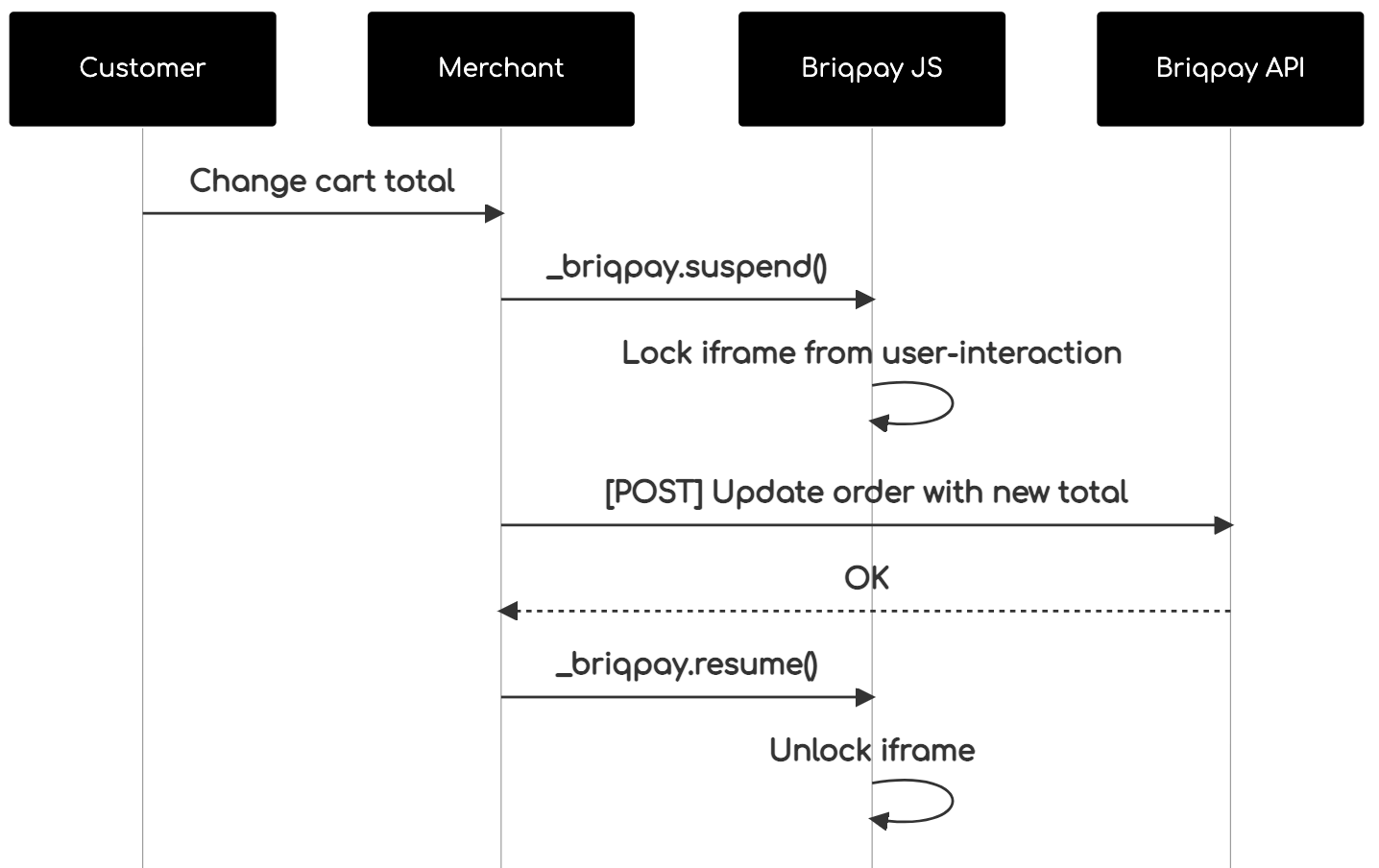 The iframe will auto-resume after 7 seconds if you dont call ``_briqpay.resume()`` before # Test Data In order to verify your integration you will neeed to use test data towards our credit engine. ## Company identication numbers * 1111111111 - To recieve a high credit scoring company ( 100 in rating) * 2222222222 - To test the enviournment with a bad credit scoring company (10 in rating) ## Card details In our playground setup your account is by default setup with a Stripe integration. In order to test out the card form you can use the below card numbers: * 4000002500003155 - To mock 3ds authentication window * 4000000000000069 Charge is declined with an expired_card code. You can use any valid expiry and CVC code # Authentication Briqpay utilizes JWT in order to authenticate calls to our platform. Authentication tokens expire after 48 hours, and at that point you can generate a new token for the given resource using the ``/auth`` endpoint. - Basic Auth - only used on the auth endpoint in order to get the Bearer Token - JWT Bearer Token - All calls towards the API utlizes this method"
bamalik1996/ipa-parser-php
158 Downloads
The PHP IPA ISO Parser is a robust tool tailored for extracting and interpreting data from IPA (iOS App Store Package) builds. Seamlessly dive into the core details of any IPA file, retrieve essential metadata, and streamline your iOS app analysis and deployment processes with this efficient package.
alwayscurious/app-uptime
19 Downloads
An itemised /up status page for Laravel: heartbeat history, per-check detail, and response-time charts on top of spatie/laravel-health.
loongs/render
8 Downloads
loong-swoole server-driven UI: PHP page builders (dashboard / form / table / detail / custom) that emit a versioned page-description JSON for Flutter (PC) and uni-app (H5 / App / mini program) renderers; renderer-neutral charts (fl_chart / uCharts), per-platform trimming, #[AsPage] registry, permission and field-policy extension points
wpify/raynet-api-php-sdk
733 Downloads
Cloud CRM REST API je programové rozhraní systému RAYNET CRM, které umožňuje pracovat s daty uvnitř CRM z aplikací třetích stran. Komunikace probíhá standardním protokolem HTTP s ohledem na [REST](https://en.wikipedia.org/wiki/Representational_state_transfer) principy. ## Připojení k RAYNET CRM Komunikačním protokolem je HTTP, proto je možné použít libovolnou aplikaci nebo knihovnu, která tento protokol podporuje. Pro demonstraci bude využita aplikace [curl](https://curl.haxx.se/). Alternativou je například add-on [Talend API Tester](https://chrome.google.com/webstore/detail/talend-api-tester-free-ed/aejoelaoggembcahagimdiliamlcdmfm) do prohlížeče Google Chrome. Přístup je zabezpečen pomocí basic authentication (uživatelským jménem a API klíčem) a šifrován protokolem TLSv1.2 a vyšším (HTTPS) pro zajištění maximální bezpečnosti. V hlavičce požadavku je nutné zaslat název Vaší instance (např. `moje-crm`). ```bash curl -X GET -u 'uzivatel:api-klic' -H 'X-Instance-Name: moje-crm' 'https://app.raynet.cz/api/v2/company/' ``` ## Datové typy Hodnoty jednotlivých atributů v systému RAYNET CRM jsou tvořeny několika základními datovými typy: + `Řetězec` - Textová hodnota. + `Číslo` - Číselná hodnota. V závislosti na kontextu se může jednat buď o číslo celé nebo o číslo desetinné. V desetinných číslech se používá desetinná tečka. + `Pravdivostní hodnota` - Hodnota ANO/NE. Pro hodnotu ANO lze využít true, on, yes a 1; pro hodnotu NE pak false, off, no a 0. + `Datum` - Datum jako řetězec ve formátu `yyyy-MM-dd`. + `Datum a čas` - Datum a čas jako řetězec ve formátu `yyyy-MM-dd HH:mm`. Akceptovány jsou také datum a čas ve formátu ISO8601 (např. `2022-01-01T12:00:00.000+01:00`). + `Reference` - Datový typ reference odkazuje na jiný záznam v systému RAYNET CRM. V příchozích datech je reference mapou (JavaScriptový objektem), která obsahuje klíče: + id - Identifikátor referencovaného záznamu. ### Datum a čas Datum a čas jako řetězec ve formátu `yyyy-MM-dd HH:mm` je v časové zóně uživatele, přes kterého jsou API požadavky realizovány. Pro filtrování a zápis (`PUT`, `POST`) je možné využít oba formáty (`yyyy-MM-dd HH:mm`, ISO8601). V response je ve výchozím stavu datum a čas formátován jako `yyyy-MM-dd HH:mm` v časové zóně uživatele. Přidáním parametru `dateFormat=ISO8601` lze ovlivnit výstupní formát, kdy bude hodnota formátována do tvaru `2022-01-01T12:00:00.000+01:00`. např. `https://ww....company/?dateFormat=ISO8601` ## Filtrování seznamu Operátory pracující nad atributy a hodnotami jsou následující: + `EQ` - Test na rovnost hodnot. + `EQ_OR_NULL` - Test na rovnost nebo prázdnou hodnotu. + `NE` - Test na nerovnost hodnot. + `NE_OR_NULL` - Test na nerovnost nebo prázdnou hodnotu. + `LT` - Hodnota v databázi je menší než zadaná. + `LE` - Hodnota v databázi je menší nebo rovna než zadaná. + `GT` - Hodnota v databázi je větší než zadaná. + `GE` - Hodnota v databázi je větší nebo rovna než zadaná. + `LIKE` - Test na hodnotu odpovídající výrazu (např. hodnota filtru ABC% nalezne všechny záznamy, které začínají znaky ABC). + `LIKE_NOCASE` - Obdoba LIKE, ale bez ohledu na malá a velká písmena. + `IN` - Test na rovnost (více) hodnot oddělených čárkou. Správný formát vstupu je např.: `1,2,3,4`. + `NOT_IN` - Test na nerovnost (více) hodnot oddělených čárkou. Správný formát vstupu je např.: `1,2,3,4`. + `CUSTOM` - Speciální operátor - chování testu je popsáno dále v dokumentaci. Výchozím operátorem je rovnost `EQ`. Operátor se zapisuje do hranatých závorek za název atributu. Je tak možné zadat více filtrovacích kritérií nad stejným atributem. `https://app..../?validFrom[GT]="2014-06-01"&validTill[LT]="2014-06-10"` Častým scénářem je vyfiltrování všech záznamů, které mají daný atribut prázdný nebo naopak neprázdný. Pro tyto účely lze použít hodnotu `prázdný řetězec` v kombinaci s operátorem `EQ` nebo `NE`. ## Uspořádání seznamu Uspořádání seznamu je kontrolováno parametrem `sortColumn` a `sortDirection`. U každého API je výčet hodnot, pomocí kterých lze seznam řadit. Parametr `sortDirection` může nabývat hodnot: + `ASC` - Hodnoty jsou řazeny vzestupně + `DESC` - Hodnoty jsou řazeny sestupně ## Stránkování seznamu Seznam je možné stránkovat nastavením parametrů `offset` a `limit`. Offset udává první záznam, který bude zobrazen, limit pak počet záznamů. Maximální velikost stránky je 1 000 položek. Například `https://app..../?offset=0&limit=2` ## Fulltext Ve většině seznamů je možné využít fulltextové vyhledání podle zadaného textového řetězce. Slouží k tomu parametr `fulltext`, který se aplikuje např. takto: `https://app..../?fulltext=nejakytext` ## Limity API Každá API odpověď obsahuje hlavičky, které popisují stav využití API pro danou instanci. ``` curl -X GET -u 'uzivatel:api-klic' -H 'X-Instance-Name: moje-crm' 'https://app.raynet.cz/api/v2/company/' HTTP/1.1 200 OK Status: 200 OK X-Ratelimit-Limit: 24000 X-Ratelimit-Remaining: 23999 X-Ratelimit-Reset: 1508889600 ``` Význam jednotlivých hlaviček je následující: | Hlavička | Význam | | -------- | ------ | | X-Ratelimit-Limit | Celkový limit pro aktuální časové okno a instanci. | | X-Ratelimit-Remaining | Zbývající počet požadavků. | | X-Ratelimit-Reset | Čas, kdy bude vyprší časové okno a limit bude resetován. Hodnota udává [unixový čas](https://cs.wikipedia.org/wiki/Unixov%C3%BD_%C4%8Das). | Pokud je limit překročen, je navrácena chybová hláška s HTTP kódem `429 Too Many Requests`: ```json { "type": "RequestLimitReached", "message": "API request limit reached. See the X-RateLimit-* headers and check out the API documentation for more details." } ``` ### Co když mi limity nestačí Ve výchozím stavu je přístup limitován na 24 000 požadavků za den (uvažováno od půlnoci do další půlnoci v časové zóně UTC). V případě, že limit pro vaši integraci nestačí, kontaktujte naší zákaznickou podporu na e-mailu [email protected] a spolu se určitě dobereme vhodného řešení. ### Špatné přihlášení V případě zaslaní více než 20 požadavků se špatnými přihlašovacími údaji, bude tento přístup na 60 minut zablokován. Toto omezení platí pro konkrétní IP adresu.
engrshishir/app-info
5 Downloads
A simple package to retrieve app information such as name, version, and environment.
crawlora/googleplay
3 Downloads
Crawlora Google Play API client with 11 endpoints for app search, details, reviews, ratings, permissions, data safety, charts, similar apps, and developers
crawlora/appstore
3 Downloads
Crawlora App Store API client with 15 endpoints for app search, details, reviews, ratings, privacy labels, version history, charts, editorial collections, and developers
furkankufrevi/laravel-slow-query-detector
0 Downloads
Detect slow queries and N+1 problems in your Laravel app. Logs warnings with query details, execution time, and origin.
wessama/google-play-version-scraper
767 Downloads
Scrapes the Google Play Store details page for an Android app to get its current version
sdksio/google-maps-platform-sdk
0 Downloads
Get location data for over 200 million places, and add place details, search, and autocomplete to your apps.
ordereazi/commerce-sdk
6 Downloads
Build a fully custom headless storefront - your own web app, mobile app, or POS - against a single OE Commerce store. Every endpoint below is namespaced under `/api/v1/store/...`. Building admin/back-office tooling instead? See [/docs/admin](/docs/admin). New here? [/guides/store](/guides/store) walks through getting a key, the anonymous cart session, and calling your first endpoints step by step - this page is the field-level reference to come back to afterward. ## Getting Started 1. Click the **Authorize** button at the top of this page. 2. Provide credentials: - **X-Commerce-Key** (always required) - your store's Store Access Key from Backoffice > Settings > Application APIs. `pk_store_...` (publishable) is safe for browser/mobile code; `sk_store_...` (secret) is server-to-server only and is rejected outright if a browser Origin header is present. - **Bearer** (only for endpoints acting on a specific customer - Account, Orders, Wishlists, etc.) - the token from **Auth > register** or **Auth > login**. Once authorized, you can explore and test all available endpoints directly from this interface. ## Anonymous Carts A guest cart is tracked by an `X-Session-Ref` header, not a cookie - the server generates one on your first request and echoes it back on every response after. Keep sending back whatever value you last received. Logging in carries that same cart forward onto the customer's account automatically, with no separate merge step. ## Errors Failures use RFC 9457 Problem Details (`application/problem+json`) with a stable `code` field for programmatic handling, e.g. `store_key_invalid`, `store_key_revoked`, `store_key_scope_denied`, `rate_limited`. A rejected *business* action (e.g. adding fewer than a product's minimum order quantity to the cart) instead comes back as HTTP 200 with `"success": false` and a human-readable `message` - always check `success` in the body, not just the HTTP status code. ## Rate Limits Requests are limited per Store Access Key (200/minute). The credential-stuffing surface (register/login/forgot-password/reset-password) is limited more tightly per caller IP (10 per 5 minutes). A 429 response includes a `Retry-After` header.