Libraries tagged by api-documentation
cofa/laravel-api-docs
104 Downloads
Zero-config, structure-agnostic API documentation generator for Laravel. Scans every route, infers headers, body, query and URL parameters plus expected responses, and renders them as beautiful Blade documentation inside your own project.
code-orange/jot
9329 Downloads
Laravel package that generates RESTful API documentation in Markdown based on PHPDoc.
briqpay/php-sdk
12160 Downloads
This is the API documentation for Briqpay. You can find out more about us and our offering at our website [https://briqpay.com](https://briqpay.com) In order to get credentials to the playgrund API Please register at [https://app.briqpay.com](https://app.briqpay.com) # Introduction Briqpay Checkout is an inline checkout solution for your b2b ecommerce. Briqpay Checkout gives you the flexibility of controlling your payment methods and credit rules while optimizing the UX for your customers # SDKs Briqpay offers standard SDKs to PHP and .NET based on these swagger definitions. You can download them respively or use our swagger defintitions to codegen your own versions. #### For .NET `` Install-Package Briqpay `` #### For PHP `` composer require briqpay/php-sdk `` # Standard use-case As a first step of integration you will need to create a checkout session. \n\nIn this session you provide Briqpay with the basic information necessary. In the response from briqpay you will recieve a htmlsnippet that is to be inserted into your frontend. The snippet provided by briqpay will render an iframe where the user will complete the purchase. Once completed, briqpay will redirect the customer to a confirmation page that you have defined. 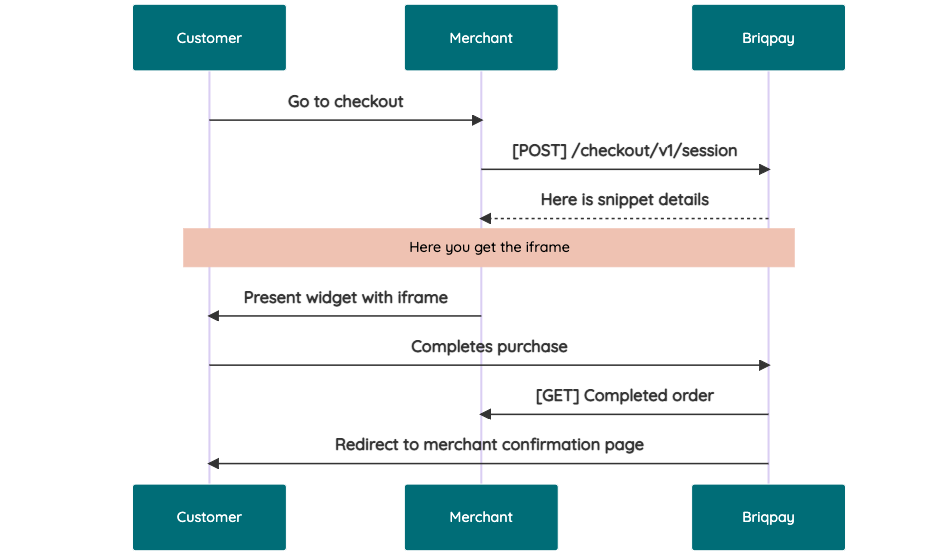 # JavaScript SDK The first step of integration is to add our JS to your site just before closing the ```` tag. This ensures that our JS library is avaliable to load the checkout. ```` Briqpay offers a few methods avaliable through our Javascript SDK. The library is added by our iframe and is avalable on ``window._briqpay`` If you offer the posibility to update the cart or order amonts on the checkout page, the JS library will help you. If your store charges the customer different costs and fees depening on their shipping location, you can listen to the ``addressupdate``event in order to re-calculate the total cost. ```javascript window._briqpay.subscribe('addressupdate', function (data) { console.log(data) }) ``` If your frontend needs to perform an action whe the signup has completed, listen to the ``signup_finalized`` event. ```javascript window._briqpay.subscribe('signup_finalized', function (status) { // redirect or handle status 'success' / 'failure' }) ``` If you allow customers to change the total cart value, you can utilise the JS library to suspend the iframe while you perform a backen update call towards our services. As described below: 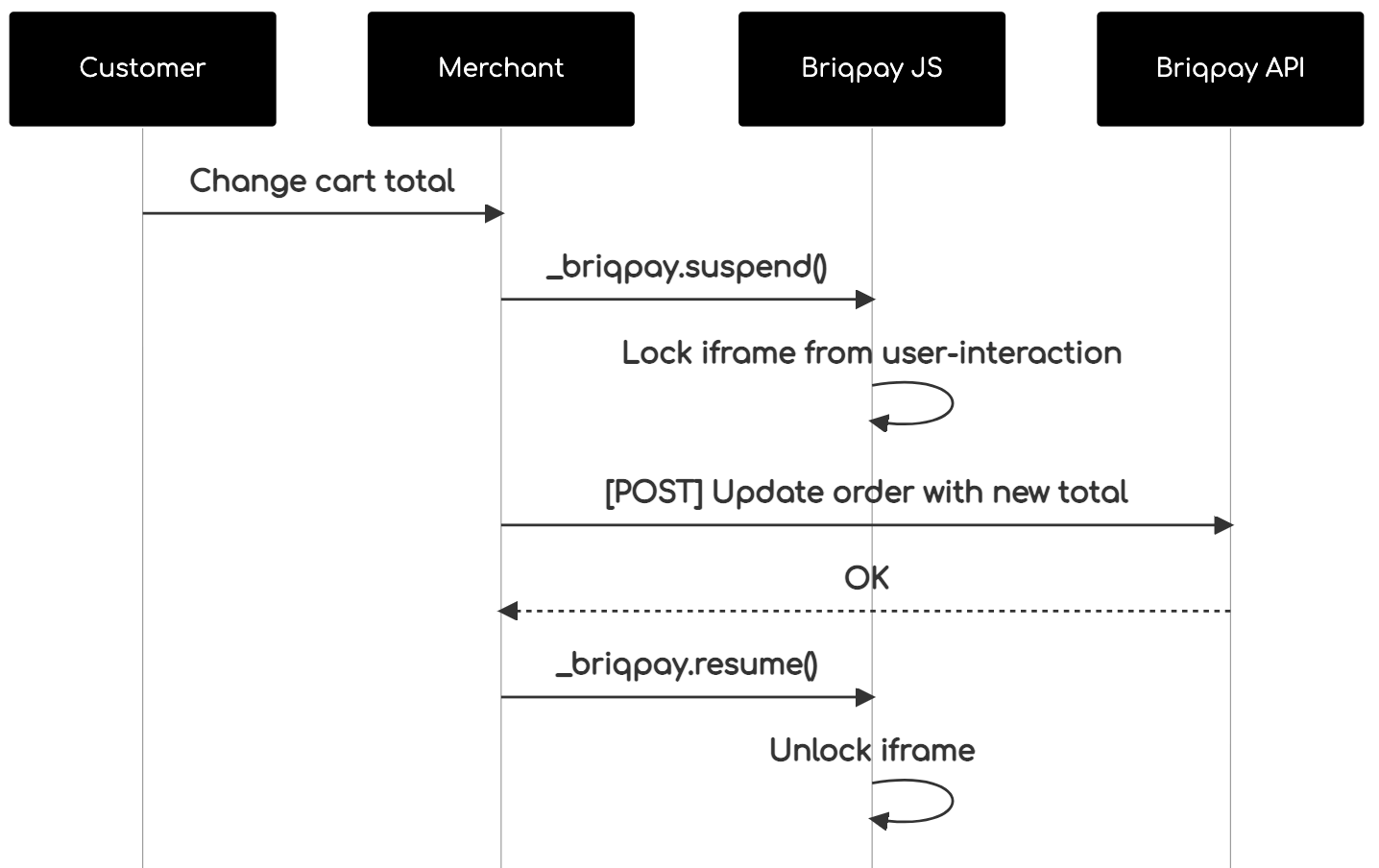 The iframe will auto-resume after 7 seconds if you dont call ``_briqpay.resume()`` before # Test Data In order to verify your integration you will neeed to use test data towards our credit engine. ## Company identication numbers * 1111111111 - To recieve a high credit scoring company ( 100 in rating) * 2222222222 - To test the enviournment with a bad credit scoring company (10 in rating) ## Card details In our playground setup your account is by default setup with a Stripe integration. In order to test out the card form you can use the below card numbers: * 4000002500003155 - To mock 3ds authentication window * 4000000000000069 Charge is declined with an expired_card code. You can use any valid expiry and CVC code # Authentication Briqpay utilizes JWT in order to authenticate calls to our platform. Authentication tokens expire after 48 hours, and at that point you can generate a new token for the given resource using the ``/auth`` endpoint. - Basic Auth - only used on the auth endpoint in order to get the Bearer Token - JWT Bearer Token - All calls towards the API utlizes this method"
spryker/rest-api-documentation-generator-extension
80017 Downloads
RestApiDocumentationGeneratorExtension module
zidbih/laravel-liveapi
1 Downloads
Generate accurate OpenAPI specifications by observing real Laravel API traffic at runtime, with zero configuration and no annotations.
thecichos/auto-documentation
10 Downloads
Automatic API and code documentation generation using PHPdocs
sakadigital/api
56 Downloads
Package for build Rest Api for your application
route2api/route2api
4 Downloads
Generate OpenAPI and Markdown API documents from ThinkPHP routes and controllers.
g4t/documentation
26 Downloads
Auto Generate Laravel api Documentation
danmahara/laravel-openapi
4 Downloads
Attribute-based OpenAPI 3.1 documentation generator for Laravel, with automatic schema inference from FormRequests and API Resources.
breadhead/yii2-swagger
1858 Downloads
Swagger Documentation Generator for Yii2 Framework with swagger v3.0
botnetdobbs/laravel-luminous
6 Downloads
PHP 8 Attribute-driven OpenAPI 3.2 documentation for Laravel
andrey-tech/amocrm-api-v2-docs
8 Downloads
Архив документации по REST API amoCRM v2 в формате HTML
zippendo/zippendo-php
24 Downloads
Public API documentation for Zippendo. Authenticate using your API token (Bearer token prefixed with zipp_). **Brands (sub-accounts).** An organization can be split into brands, each keeping its own orders, shipments and configuration separate. There are two ways to scope requests to one brand, and NEITHER changes any request body: 1. **Bind the token.** Create an API token with a `brandId` and every request it makes is confined to that brand — reads filtered, writes stamped. This is the recommended way to give a single brand's team its own credential. 2. **Send the `X-Zippendo-Brand` header.** An organization-wide token can scope an individual request by sending the brand's id or slug in this header. Most SDKs let you set it once on the client so every call inherits it. A brand-bound token that receives an `X-Zippendo-Brand` header naming a different brand is rejected with `403 BRAND_ACCESS_DENIED` — the binding is never widened. Omit both and requests cover the whole organization, which is the behaviour of every existing token. Records that belong to no brand carry `brandId: null`. Configuration (carriers, shipping rules, addresses) with a null brand is organization-wide and remains visible inside every brand; orders and shipments with a null brand are only visible organization-wide. List endpoints additionally take a `?brandScope=own|shared|both` parameter to narrow further within whichever brand context already applies. `own` returns only rows assigned to that brand, and requires a brand context — a brand-bound token, a resolved brand session, or the `X-Zippendo-Brand` header above — otherwise `400`. `shared` returns only the organization-wide rows (equivalent to filtering `brandId=none`). The default, `both`, keeps the existing behaviour: a brand context sees its own rows plus the organization-wide ones. Set `X-Zippendo-Brand-Scope` as a client default to apply the same choice to every request instead of repeating the query parameter on each call — an explicit `brandScope` query parameter always wins over the header, and a blank header value is ignored. Brands themselves are managed under the **Brands** tag. Retiring a brand is done with `POST /orgs/{orgId}/brands/{brandId}/archive` — permanent deletion is a dashboard-only action, since it is refused while any order, shipment, member or token still references the brand. Brands require a plan that includes them; creating one beyond your plan's limit returns `403`.
yunbuye/thinkphp-apidoc-generator
91 Downloads
Generate beautiful API documentation from your ThinkPHP application