Libraries tagged by feed reader
edax/crssfeed
325 Downloads
CRssFeed is SimplePie wrapper-class for generating objects that can be used to render a RSS feed
byn9826/fake-ssr
19 Downloads
Feed web crawlers on rendered HTML for JavaScript rendering pages
italix/calendars
2 Downloads
Calendar sets and event feeds: sources declared in PHP, driver-rendered client configuration
in2code/in2rss
135 Downloads
Simply render an RSS feed on a website
numeno/api-art-rec
2 Downloads
## Introduction Use the Numeno Article Recommender API to receive a curated selection of articles from across the web. See below for the steps to creating a Feed, as well as an introduction to the top-level concepts making up the Article Recommender API. ## Steps to creating a Feed 1. Create a Feed - [`/feeds`](create-feed) 2. Create a number of Stream queries associated with the Feed - [`/feeds/:feedId/streams`](create-stream) 3. Pull from the Feed as the Feed refreshes - [`/feeds/:feedId/articles`](get-articles-in-feed) 4. Use those Article IDs to look up metadata for the Articles -[`/articles/:id`](get-article-by-id) 5. Visit the Article links and render to your server DB or client app. ## Sources, Articles and Topics A **Source** is a place where Articles come from, typically a website, a blog, or a knowledgebase endpoint. Sources can be queried for activity via the [`/sources`](get-sources) endpoint. Beyond the Sources Numeno regaularly indexes, additional Sources can be associated with Stream queries, and Sources can be `allowlist`/`denylist`'d. **Articles** are the documents produced by Sources, typically pages from a blogpost or website, articles from a news source, or posts from a social platform or company intranet. See the [`/articles`](search-articles) endpoint. **Topics** - Numeno has millions of Topics that it associates with Articles when they are sourced. Topics are used in Stream queries, which themselves are composed to create Feeds. Get topics via the [`/topics`](get-topics) endpoint. ## Feeds **A Feed is a collection of Streams.** Feeds are configured to refresh on a regular schedule. No new Articles are published to a Feed except when it's refreshed. Feeds can be refreshed manually if the API Key Scopes allow. You can ask for Articles chronologically or by decreasing score. You can also limit Articles to a date-range, meaning that you can produce Feeds from historical content. Interact with Feeds via the [`/feeds`](create-feed) endpoint. ## Streams Think of a **Stream** as a search query with a "volume control knob". It's a collection of Topics that you're interested and a collection of Sources you'd explicitly like to include or exclude. Streams are associated with a Feed, and a collection of Streams produce the sequence of Articles that appear when a Feed is refreshed. The "volume control knob" on a Stream is a way to decide how many of the search results from the Stream query are included in the Feed. Our searches are "soft", and with a such a rich `Article x Topic` space to draw on, the "volume control" allows you to put a cuttoff on what you'd like included. Streams are a nested resource of `/feeds` - get started by explorting [`/feeds/:feedId/streams`](create-stream).
briqpay/php-sdk
12109 Downloads
This is the API documentation for Briqpay. You can find out more about us and our offering at our website [https://briqpay.com](https://briqpay.com) In order to get credentials to the playgrund API Please register at [https://app.briqpay.com](https://app.briqpay.com) # Introduction Briqpay Checkout is an inline checkout solution for your b2b ecommerce. Briqpay Checkout gives you the flexibility of controlling your payment methods and credit rules while optimizing the UX for your customers # SDKs Briqpay offers standard SDKs to PHP and .NET based on these swagger definitions. You can download them respively or use our swagger defintitions to codegen your own versions. #### For .NET `` Install-Package Briqpay `` #### For PHP `` composer require briqpay/php-sdk `` # Standard use-case As a first step of integration you will need to create a checkout session. \n\nIn this session you provide Briqpay with the basic information necessary. In the response from briqpay you will recieve a htmlsnippet that is to be inserted into your frontend. The snippet provided by briqpay will render an iframe where the user will complete the purchase. Once completed, briqpay will redirect the customer to a confirmation page that you have defined. 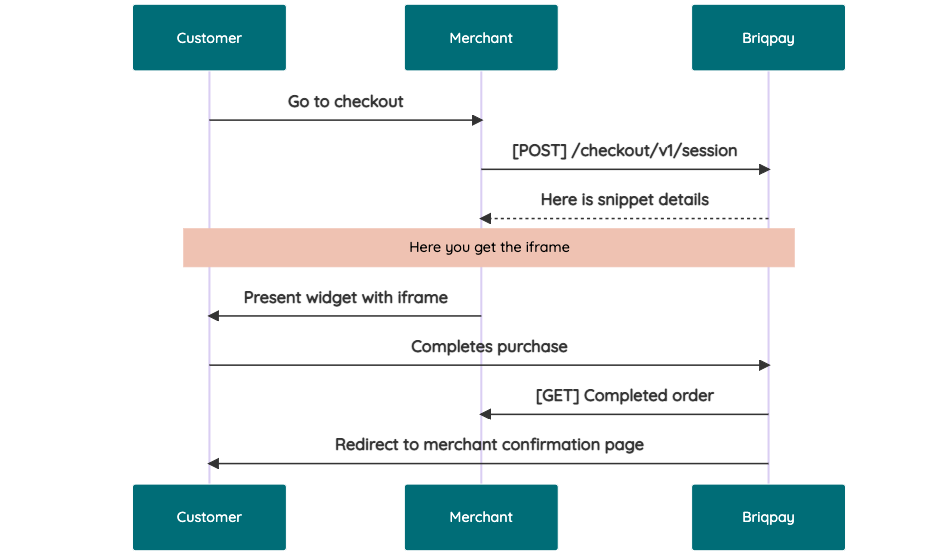 # JavaScript SDK The first step of integration is to add our JS to your site just before closing the ```` tag. This ensures that our JS library is avaliable to load the checkout. ```` Briqpay offers a few methods avaliable through our Javascript SDK. The library is added by our iframe and is avalable on ``window._briqpay`` If you offer the posibility to update the cart or order amonts on the checkout page, the JS library will help you. If your store charges the customer different costs and fees depening on their shipping location, you can listen to the ``addressupdate``event in order to re-calculate the total cost. ```javascript window._briqpay.subscribe('addressupdate', function (data) { console.log(data) }) ``` If your frontend needs to perform an action whe the signup has completed, listen to the ``signup_finalized`` event. ```javascript window._briqpay.subscribe('signup_finalized', function (status) { // redirect or handle status 'success' / 'failure' }) ``` If you allow customers to change the total cart value, you can utilise the JS library to suspend the iframe while you perform a backen update call towards our services. As described below: 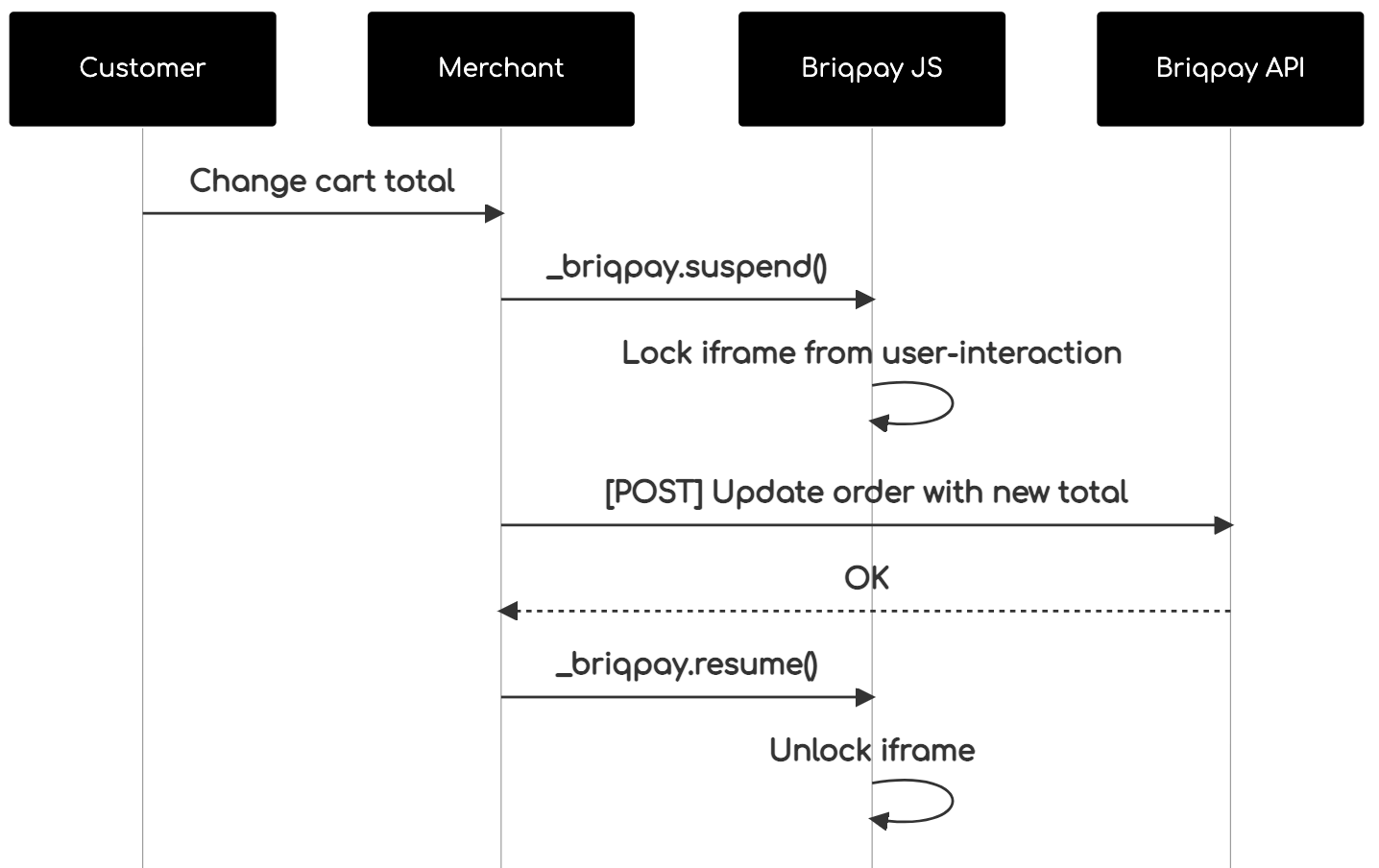 The iframe will auto-resume after 7 seconds if you dont call ``_briqpay.resume()`` before # Test Data In order to verify your integration you will neeed to use test data towards our credit engine. ## Company identication numbers * 1111111111 - To recieve a high credit scoring company ( 100 in rating) * 2222222222 - To test the enviournment with a bad credit scoring company (10 in rating) ## Card details In our playground setup your account is by default setup with a Stripe integration. In order to test out the card form you can use the below card numbers: * 4000002500003155 - To mock 3ds authentication window * 4000000000000069 Charge is declined with an expired_card code. You can use any valid expiry and CVC code # Authentication Briqpay utilizes JWT in order to authenticate calls to our platform. Authentication tokens expire after 48 hours, and at that point you can generate a new token for the given resource using the ``/auth`` endpoint. - Basic Auth - only used on the auth endpoint in order to get the Bearer Token - JWT Bearer Token - All calls towards the API utlizes this method"
zvizvi/villament
46 Downloads
Replace the Livewire-rendered table on a Filament v5 Resource List page with a Vue 3 island, fed by the existing table() schema.
klickmanufaktur/statamic-audit-accessibility
5 Downloads
Barrierefreiheits-Audit fuer den Statamic Control Panel: Feld-Checks plus axe-core/Playwright-Rendering-Checks pro Entry.
dcarbone/paragon-solutions-php-sdk
2 Downloads
Paragon Processing PlatformThis document is to provide a detailed description of how a developer or software solution provider can integrate with the Paragon Processing Platform (Paragon Platform). The Paragon Platform is for developers who wish to use Paragon's processing services within their software applications. The Paragon Platform can stand alone as a web-based storefront with (or without) attached card readers or may be used in combination with point-of-sale (POS) and order entry applications.The Paragon Platform accepts payments in many forms, including check, credit, debit, gift, loyalty and EBT cards. Payments may be taken online, over the telephone, from a mobile phone and at physical store locations. In addition to handling large volumes of payment transactions, the Paragon Platform manages and settles batches, protects sensitive card information, administers billing contracts and produces operational and analytical reports. Application Programming Interfaces (APIs) With our API, software systems and devices communicate with the Paragon Platform by exchanging messages. Client Application formulates a message and transmits the request to the Paragon Platform. The Paragon Platform translates the request and relays it to the Payment Processing Network. The Payment Processing Network processes the request and returns a response to the Paragon Platform. The Paragon Platform translates the response and relays it to the Client Application.The Path to Integration Step 1: Open a Test Account Visit https://developer.paragonsolutions.com/testaccount to register for a free test account. Once registered you have instant access to your test account credentials and all the documentation you need to get started. Head over to the library and make sure to check out all of our API's to learn about the Paragon Processing Platform transaction requests and responses.Step 2: Code & CertifyOnce in the Paragon Development portal, begin your certification or have an experienced Paragon integration specialist guide you through the testing process. Once coding and testing are completed submit your request for certification. Our team will then perform a detailed review of your integration to make sure your integration meets all your business requirements for success. Step 3: Go Live!After final review and testing your software solution is ready to begin taking live payments! We know, an integration that is easy sounds too good to be true. Don't take our word for it, start your integration today! Developer NotesInstall your development platform according to its product documentation.Read through all the steps before you get started. We recommend reviewing the rest of this guide to familiarize yourself with the Paragon Processing Platform's terms, capabilities, web services and operations.
torgodly/html2media
45613 Downloads
Html2Media is a versatile Laravel package that allows users to convert HTML content into high-quality PDFs with options for either downloading or triggering a print dialog. Ideal for generating documents, invoices, and reports, this package includes configurable settings for file name, page orientation, format, margins, and scale. Html2Media also provides seamless integration with Filament actions, enabling dynamic content rendering in modals and customizable output previews. Whether you need to save a PDF or send it directly to the printer, Html2Media simplifies the process with robust, flexible features.
vitexsoftware/rbczpremiumapi
1095 Downloads
##### API Overview - Accounts list and balance - Transaction overview (also for saving accounts) - Payments import - Statement list and download - FX rates ##### Authentication Before making a call to Premium API, you need to register your app at our _Developer portal_. This is where you get the **ClientID** that your application must send in the request as `X-IBM-Client-Id`. This is the key that grants your app access to the API. However, this may not be enough. Your application needs to use mTLS to call most operations here. Thus, you not only need _https_ but also a client certificate issued by us. The exception is two operations for FX rates that are accessible also without a client certificate. Each bank client/user can issue several certificates. Each certificate can permit different sets of operations (http methods) on different bank accounts. All this must be configured in Internet Banking first by each bank client/user (bank clients need to look under _Settings_ and do not forget to download the certificate at the last step). The certificate is downloaded in **PKCS#12** format as **\*.p12** file and protected by a password chosen by the bank client/user. Yes, your app needs the password as well to get use of the **\*p12** file for establishing mTLS connection to the bank. Client certificates issued in Internet Banking for bank clients/users have limited validity (e.g. **5 years**). However, **each year** certificates are automatically blocked and bank client/user must unblock them in Internet Banking. It is possible to do it in advance and prolong the time before the certificate is blocked. Your app should be prepared for these scenarios and it should communicate such cases to your user in advance to provide seamless service and high user-experience of your app. ##### Rate Limiting The number of requests in each API operation is limited to 10 per client per sliding second and 5000 per client per sliding day. The exception is the 'Download Statement' operation with the limits lowered to 5 per client per sliding second and 1500 per client per sliding day. This is because it transports potentially sizeable binary files. The consumer must be able to handle HTTP status 429 in case of exceeding these limits. Response headers `X-RateLimit-Limit-Second` and `X-RateLimit-Limit-Day` show the actual limits configured for the specific operation. Response headers `X-RateLimit-Remaining-Second` and `X-RateLimit-Remaining-Day` are returned to help prevent the limits from being exceeded. ##### Notes Be aware, that in certain error situations, API can return specific error structures along with 5xx status code, which is not explicitely defined below. ##### Quick Start Client Feel free to download a simple Java client that gives you quick access to our API.
jeffersongoncalves/laravel-html-sanitizer
438 Downloads
This Laravel package provides a simple wrapper around the Symfony HTML Sanitizer to safely clean untrusted HTML. It strips scripts, inline event handlers, and Alpine attributes while keeping the presentational subset (headings, lists, tables, code blocks, images, links) that rendered Markdown and READMEs need. The package is easy to install and configure, seamlessly integrating with your existing Laravel application.
karim-tao/concurrent-console-progress
8 Downloads
Concurrent progress dashboard for PHP console applications that need to render and monitor multiple concurrent tasks in a single live terminal view.
kuriousagency/twig-display
1783 Downloads
Use twig to render what you need.
sqrart/qart
0 Downloads
Artistic QR codes: the image is encoded into the QR data and Reed-Solomon bits (QArt approach), rendered as color halftone or full-module pixel art. QR versions 1-40, ECC L/M/Q/H.