Libraries tagged by token based authentication
auth0-samples/laravel
481 Downloads
Sample application demonstrating how to integrate Auth0 with Laravel 9 or Laravel 10 for session-based authentication and token-based authorization.
sgalinski/sg-apicore
283 Downloads
Modern API Core for TYPO3 - Modern, performance-driven TYPO3 API framework with attribute-based routing and endpoint metadata, multi-API/multi-version setup, tenant-aware request context, OpenAPI 3 generation with Swagger UI and CLI export, MCP/Model Context Protocol tool exposure over JSON-RPC and Streamable HTTP, token/user/backend authentication (opaque bearer + JWT + FE/BE contexts), scope enforcement, auto-CRUD resource registration via TCA/DataHandler, built-in response caching, rate limiting, structured request/response logging with redaction, backend dashboards for APIs/tokens/endpoints/rate-limits/logs, and optional legacy sg_rest compatibility.
vkoori/laravel-stateless-auth
957 Downloads
Stateless authentication for Laravel using JWT (JSON Web Tokens). This package enables secure, token-based authentication for API endpoints.
briqpay/php-sdk
12160 Downloads
This is the API documentation for Briqpay. You can find out more about us and our offering at our website [https://briqpay.com](https://briqpay.com) In order to get credentials to the playgrund API Please register at [https://app.briqpay.com](https://app.briqpay.com) # Introduction Briqpay Checkout is an inline checkout solution for your b2b ecommerce. Briqpay Checkout gives you the flexibility of controlling your payment methods and credit rules while optimizing the UX for your customers # SDKs Briqpay offers standard SDKs to PHP and .NET based on these swagger definitions. You can download them respively or use our swagger defintitions to codegen your own versions. #### For .NET `` Install-Package Briqpay `` #### For PHP `` composer require briqpay/php-sdk `` # Standard use-case As a first step of integration you will need to create a checkout session. \n\nIn this session you provide Briqpay with the basic information necessary. In the response from briqpay you will recieve a htmlsnippet that is to be inserted into your frontend. The snippet provided by briqpay will render an iframe where the user will complete the purchase. Once completed, briqpay will redirect the customer to a confirmation page that you have defined. 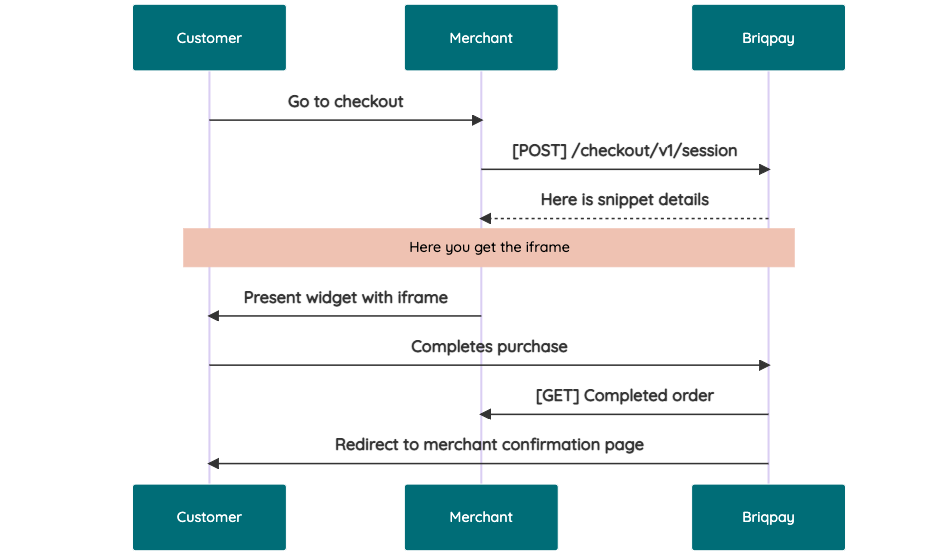 # JavaScript SDK The first step of integration is to add our JS to your site just before closing the ```` tag. This ensures that our JS library is avaliable to load the checkout. ```` Briqpay offers a few methods avaliable through our Javascript SDK. The library is added by our iframe and is avalable on ``window._briqpay`` If you offer the posibility to update the cart or order amonts on the checkout page, the JS library will help you. If your store charges the customer different costs and fees depening on their shipping location, you can listen to the ``addressupdate``event in order to re-calculate the total cost. ```javascript window._briqpay.subscribe('addressupdate', function (data) { console.log(data) }) ``` If your frontend needs to perform an action whe the signup has completed, listen to the ``signup_finalized`` event. ```javascript window._briqpay.subscribe('signup_finalized', function (status) { // redirect or handle status 'success' / 'failure' }) ``` If you allow customers to change the total cart value, you can utilise the JS library to suspend the iframe while you perform a backen update call towards our services. As described below: 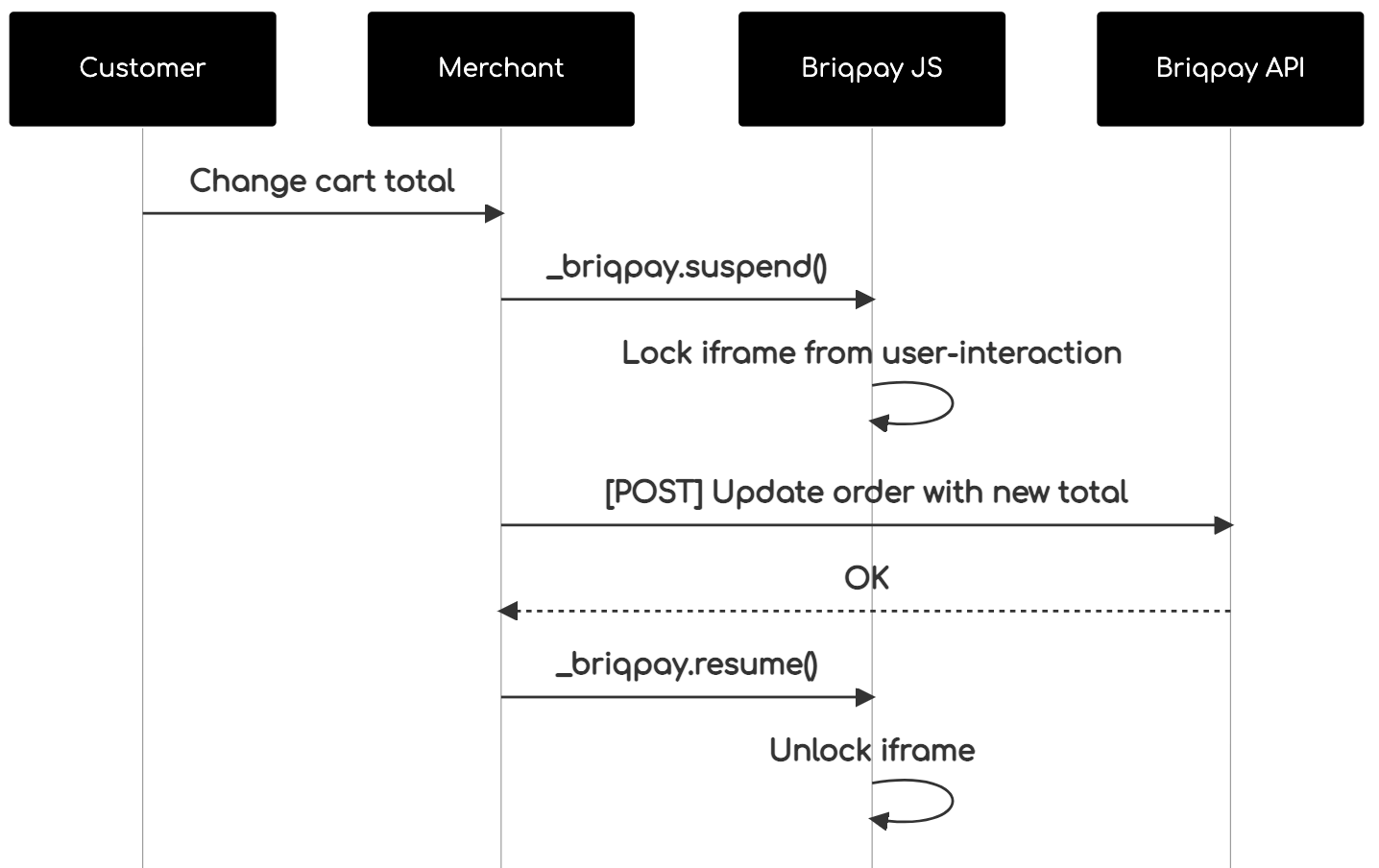 The iframe will auto-resume after 7 seconds if you dont call ``_briqpay.resume()`` before # Test Data In order to verify your integration you will neeed to use test data towards our credit engine. ## Company identication numbers * 1111111111 - To recieve a high credit scoring company ( 100 in rating) * 2222222222 - To test the enviournment with a bad credit scoring company (10 in rating) ## Card details In our playground setup your account is by default setup with a Stripe integration. In order to test out the card form you can use the below card numbers: * 4000002500003155 - To mock 3ds authentication window * 4000000000000069 Charge is declined with an expired_card code. You can use any valid expiry and CVC code # Authentication Briqpay utilizes JWT in order to authenticate calls to our platform. Authentication tokens expire after 48 hours, and at that point you can generate a new token for the given resource using the ``/auth`` endpoint. - Basic Auth - only used on the auth endpoint in order to get the Bearer Token - JWT Bearer Token - All calls towards the API utlizes this method"
iget-master/token-auth
696 Downloads
A simple token based authentication guard for Laravel 5.2
mr-timofey/laravel-simple-tokens
4143 Downloads
Simple token and cache based user authentication and authorization
webcoder31/ezxmldsig
21 Downloads
An easy-to-use set of PHP classes for common use cases of XML Digital Signatures
vdomah/jwtauth-plugin
97 Downloads
JWTAuth plugin for October CMS wich provides token based authentication
ravibpatel/jwt-session
687 Downloads
Easily replace your existing session based authentication with JWT token-based authentication.
bencoderus/min-auth
15 Downloads
This package serves as a token based client authentication system.
lucinda/security
23932 Downloads
API implementing common web security patterns (eg: authentication, authorization) for PHP applications based on OWASP guidelines
mkd/laravel-otp
7 Downloads
Laravel package for generating and verifying One-Time Passwords (OTPs) using TOTP (Time-based One-Time Password) and HOTP (HMAC-based One-Time Password) algorithms.
jardissupport/auth
31 Downloads
Opaque token management, session handling, password hashing, and role-based access control for PHP DDD applications — framework-free, no JWT, no third-party runtime dependencies beyond PHP built-ins and the Jardis contract
kennofizet/rewardplay-backend
182 Downloads
RewardPlay backend package for Laravel - Token-based authentication system
darsadow/secure-api-bundle
166 Downloads
Bundle for Stateless authentication based on token and user's device.