Libraries tagged by order id
nogrod/tyre24-common-php-sdk
704 Downloads
## API Versioning We're constantly updating and improving the API, and while we try to ensure backwards compatibility, there's always a chance that we'll introduce a change that affects the way your app works. To get around any problems that this might cause, we recommend that you include the Accept header with every API request that you make. This header enables you to target your request to a particular version of the API. It looks like this in HTTP: ```text Accept: application/vnd.saitowag.api+json;version={version_number} ``` Normally, you set the value of the placeholder to the current version of the API. But if you're troubleshooting your app, and you know that an older version of the API works perfectly, say version 1.0, you'd substitute 1.0 for the placeholder value. The API then handles the request as if it were for version 1.0, and your app goes back to working properly. ### Example of an error with invalid `ACCEPT` header. The `HTTP status code` in case of an invalid `ACCEPT` header will be `400 Bad Request` and the following response will be returned. ```json { "data": [ { "error_code": "ERR_ACCEPT_HEADER_NOT_VALID", "error_message": "Accept header is not valid or not set." } ] } ``` ### Unexpected Error If an unexpected error occours, a so called Error General will be returned. The `HTTP status code` in case of an invalid `ACCEPT` header will be `500` and the following response will be returned. ```json { "data": [ { "error_code": "ERR_GENERAL", "error_message": "An unexpected error has occurred. If this problem persists, please contact our support." } ] } ``` ### Invalid Endpoint Error Any call to a non-existing API endpoint (i.e. wrong route) will return a response with `HTTP status code` `404` and the following response body: ```json { "data": [ { "error_code": "ERR_GENERAL_INVALID_ENDPOINT", "error_message": "The requested endpoint does not exist." } ] } ``` Please, note that this error is returned also when a request parameter, part of a valid route, is not well formed. For example, a call to a route that contains a wrong order id (i.e. it does not meet the accepted order id pattern - e.g. 123456789PAC instead of PAC123456789) will return the error just mentioned, as the route is considered as badly formed. In conclusion, please pay special attention to all those routes that have request parameters with specific pattern requirements. ### Shipping Method IDs These ids may not be available in all the countries. | ID | Name | | --- | --- | | 1 | Standard `Standard` | | 2 | Self-collection `Selbstabholung` | | 3 | Express morning (truck) `Express-Morgen (LKW)` | | 4 | Express Today (Truck) `Express-Heute (LKW)` | | 5 | Express morning (package forwarding) `Express-Morgen (Packet Spedition)` | | 7 | Express-now | ### Payment Method IDs These ids may not be available in all the countries. | ID | Name | | --- | --- | | 1 | SEPA Direct Debit `SEPA-Lastschrift` | | 2 | Prepayment `Vorkasse` | | 3 | Cash on delivery `Nachnahme` | | 4 | PayPal/Credit Card `PayPal/Kreditkarte` | | 5 | open payment method `offene Zahlungsart` | | 7 | Invoice(8 days payment term) `Rechnung(8 Tage Zahlungsziel)` | | 8 | open payment method (SEPA) `offene Zahlungsart (SEPA)` | ## Query String Filters Query String Filters | Operator | Full Name | Description | Example | | ------ | ------ | ------ | ------ | | eq | Equal | Used to narrow down the result of a query to some specific value, for specified field. It adds the "**=**" symbol to the SQL query. Eg. `{url}?filter[{alias_name}]=eq;11` will result in the following sql: `SELECT {field_name} AS {alias_name} FROM {table_name} WHERE {alias_name} = 11` | integer: `{url}?filter[id]=eq;21`float: `{url}?filter[average]=eq;3.7`string: `{url}?filter[free_text]=eq;apple`Date: `{url}?filter[birthday]=eq;2020-06-03`DateTime: `{url}?filter[created_at]=eq;2020-06-03 14:32:32`boolean: `{url}?filter[is_active]=eq;1` | | neq | Not equal | Used to exclude the value from a query result. It adds the "****" symbol to the SQL query. Eg. `{url}?filter[{alias_name}]=neq;11` will result in the following sql: `SELECT {field_name} AS {alias_name} FROM {table_name} WHERE {alias_name} 11` | integer: `{url}?filter[id]=neq;21`float: `{url}?filter[average]=neq;3.7`string: `{url}?filter[free_text]=neq;apple`Date: `{url}?filter[birthday]=neq;2020-06-03`DateTime: `{url}?filter[created_at]=neq;2020-06-03 14:32:32`boolean: `{url}?filter[is_active]=neq;1` | | gt | Greater than | Used to reduce fetched values to those greater than the one provided in a query string. It adds the "**>**" symbol to the SQL query. Eg. `{url}?filter[{alias_name}]=gt;11` will result in the following sql: `SELECT {field_name} AS {alias_name} FROM {table_name} WHERE {alias_name} > 11` | integer: `{url}?filter[id]=gt;21`float: `{url}?filter[average]=gt;3.7`Date: `{url}?filter[birthday]=gt;2020-06-03`DateTime: `{url}?filter[created_at]=gt;2020-06-03 14:32:32` | | gte | Greater than or equal | Used to reduce fetched values to those greater than or equal to the one provided in a query string. It adds the "**>=**" symbol to the SQL query. Eg. `{url}?filter[{alias_name}]=gte;11` will result in the following sql: `SELECT {field_name} AS {alias_name} FROM {table_name} WHERE {alias_name} >= 11` | integer: `{url}?filter[id]=gte;21`float: `{url}?filter[average]=gte;3.7`Date: `{url}?filter[birthday]=gte;2020-06-03`DateTime: `{url}?filter[created_at]=gte;2020-06-03 14:32:32` | | lt | Less than | Used to reduce fetched values to those less than provided in a query string. It adds the "**
carlosio/compify
172 Downloads
Including the tests and other useless information like .travis.yml in distributed packages is not a good idea. "Compify" tries to remove everything, in order to save bandwidth and disk usage, but the necessary code for the package to work in your app or library.
briqpay/php-sdk
12172 Downloads
This is the API documentation for Briqpay. You can find out more about us and our offering at our website [https://briqpay.com](https://briqpay.com) In order to get credentials to the playgrund API Please register at [https://app.briqpay.com](https://app.briqpay.com) # Introduction Briqpay Checkout is an inline checkout solution for your b2b ecommerce. Briqpay Checkout gives you the flexibility of controlling your payment methods and credit rules while optimizing the UX for your customers # SDKs Briqpay offers standard SDKs to PHP and .NET based on these swagger definitions. You can download them respively or use our swagger defintitions to codegen your own versions. #### For .NET `` Install-Package Briqpay `` #### For PHP `` composer require briqpay/php-sdk `` # Standard use-case As a first step of integration you will need to create a checkout session. \n\nIn this session you provide Briqpay with the basic information necessary. In the response from briqpay you will recieve a htmlsnippet that is to be inserted into your frontend. The snippet provided by briqpay will render an iframe where the user will complete the purchase. Once completed, briqpay will redirect the customer to a confirmation page that you have defined. 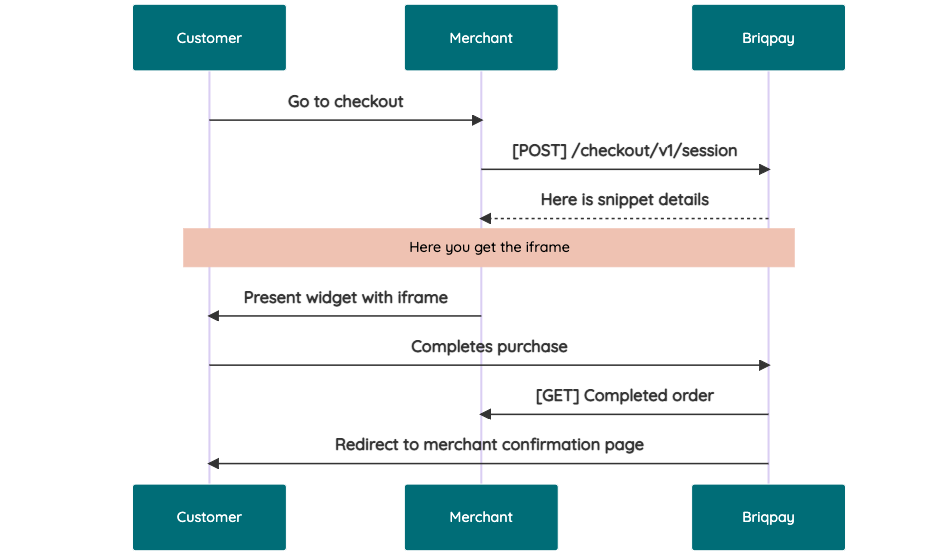 # JavaScript SDK The first step of integration is to add our JS to your site just before closing the ```` tag. This ensures that our JS library is avaliable to load the checkout. ```` Briqpay offers a few methods avaliable through our Javascript SDK. The library is added by our iframe and is avalable on ``window._briqpay`` If you offer the posibility to update the cart or order amonts on the checkout page, the JS library will help you. If your store charges the customer different costs and fees depening on their shipping location, you can listen to the ``addressupdate``event in order to re-calculate the total cost. ```javascript window._briqpay.subscribe('addressupdate', function (data) { console.log(data) }) ``` If your frontend needs to perform an action whe the signup has completed, listen to the ``signup_finalized`` event. ```javascript window._briqpay.subscribe('signup_finalized', function (status) { // redirect or handle status 'success' / 'failure' }) ``` If you allow customers to change the total cart value, you can utilise the JS library to suspend the iframe while you perform a backen update call towards our services. As described below: 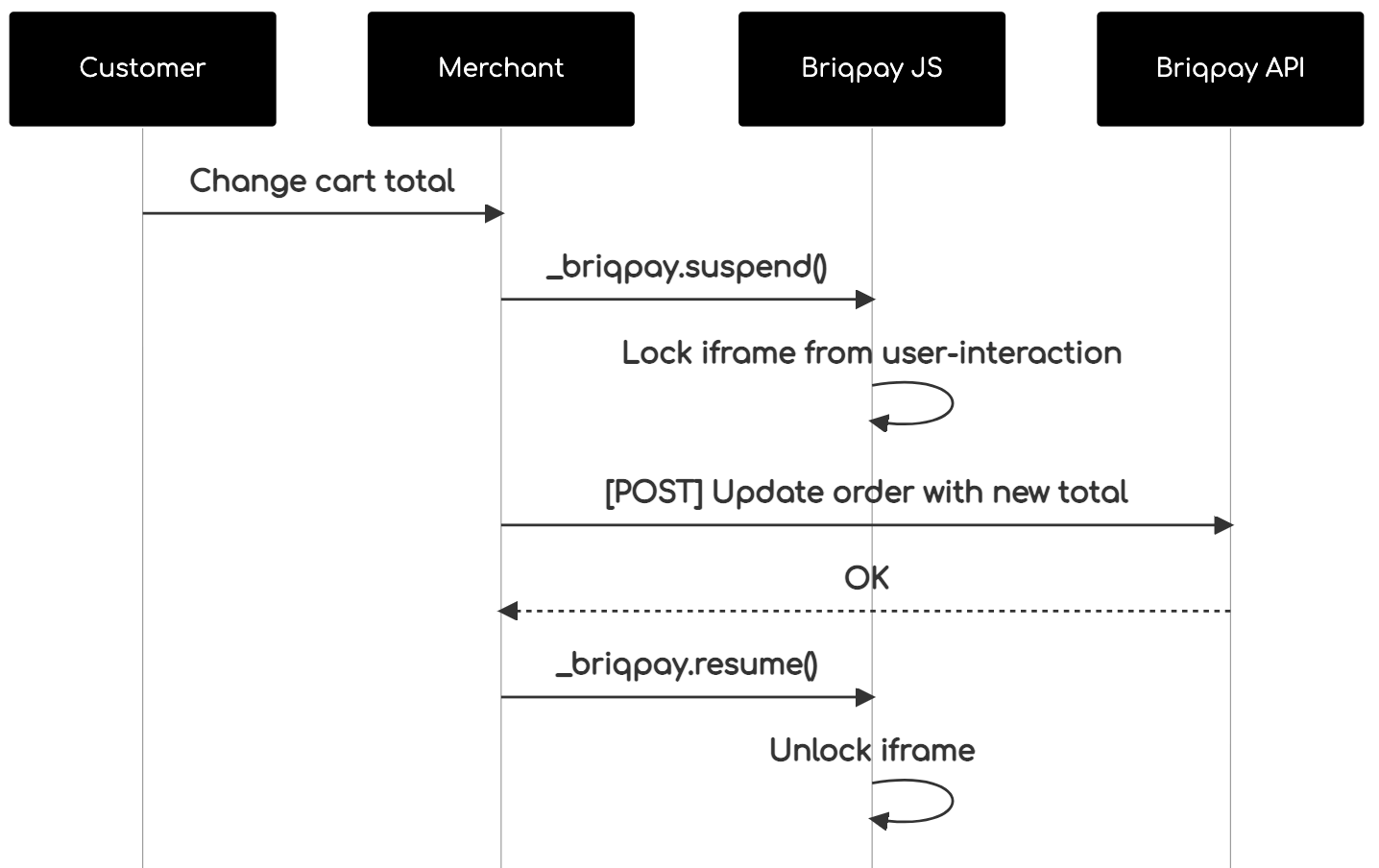 The iframe will auto-resume after 7 seconds if you dont call ``_briqpay.resume()`` before # Test Data In order to verify your integration you will neeed to use test data towards our credit engine. ## Company identication numbers * 1111111111 - To recieve a high credit scoring company ( 100 in rating) * 2222222222 - To test the enviournment with a bad credit scoring company (10 in rating) ## Card details In our playground setup your account is by default setup with a Stripe integration. In order to test out the card form you can use the below card numbers: * 4000002500003155 - To mock 3ds authentication window * 4000000000000069 Charge is declined with an expired_card code. You can use any valid expiry and CVC code # Authentication Briqpay utilizes JWT in order to authenticate calls to our platform. Authentication tokens expire after 48 hours, and at that point you can generate a new token for the given resource using the ``/auth`` endpoint. - Basic Auth - only used on the auth endpoint in order to get the Bearer Token - JWT Bearer Token - All calls towards the API utlizes this method"
psys/order-invoice-bundle
95 Downloads
Order & invoice management for Symfony, ideal for SaaS, services, and digital products.
ledc/snowflake
426 Downloads
雪花算法的PHP实现
toteph42/isotope_stin
772 Downloads
Isotope EU STIN (Umsatzsteuer-ID) management for Contao.
nastuzzi-samy/laravel-model-stages
2768 Downloads
Add stage scopes to models with parents
d3/ordermanager
1077 Downloads
Order manager module for OXID eShop.
zippendo/zippendo-php
26 Downloads
Public API documentation for Zippendo. Authenticate using your API token (Bearer token prefixed with zipp_). **Brands (sub-accounts).** An organization can be split into brands, each keeping its own orders, shipments and configuration separate. There are two ways to scope requests to one brand, and NEITHER changes any request body: 1. **Bind the token.** Create an API token with a `brandId` and every request it makes is confined to that brand — reads filtered, writes stamped. This is the recommended way to give a single brand's team its own credential. 2. **Send the `X-Zippendo-Brand` header.** An organization-wide token can scope an individual request by sending the brand's id or slug in this header. Most SDKs let you set it once on the client so every call inherits it. A brand-bound token that receives an `X-Zippendo-Brand` header naming a different brand is rejected with `403 BRAND_ACCESS_DENIED` — the binding is never widened. Omit both and requests cover the whole organization, which is the behaviour of every existing token. Records that belong to no brand carry `brandId: null`. Configuration (carriers, shipping rules, addresses) with a null brand is organization-wide and remains visible inside every brand; orders and shipments with a null brand are only visible organization-wide. List endpoints additionally take a `?brandScope=own|shared|both` parameter to narrow further within whichever brand context already applies. `own` returns only rows assigned to that brand, and requires a brand context — a brand-bound token, a resolved brand session, or the `X-Zippendo-Brand` header above — otherwise `400`. `shared` returns only the organization-wide rows (equivalent to filtering `brandId=none`). The default, `both`, keeps the existing behaviour: a brand context sees its own rows plus the organization-wide ones. Set `X-Zippendo-Brand-Scope` as a client default to apply the same choice to every request instead of repeating the query parameter on each call — an explicit `brandScope` query parameter always wins over the header, and a blank header value is ignored. Brands themselves are managed under the **Brands** tag. Retiring a brand is done with `POST /orgs/{orgId}/brands/{brandId}/archive` — permanent deletion is a dashboard-only action, since it is refused while any order, shipment, member or token still references the brand. Brands require a plan that includes them; creating one beyond your plan's limit returns `403`.
hananils/kirby-type-methods
46 Downloads
Type Methods helps to identify the type of an object, either page, user or file, in order to simplify logic in snippets that – for instance – handle content from both $page and $user objects.
citypay/citypay-api-client-php
165 Downloads
Welcome to the CityPay API, a robust HTTP API payment solution designed for seamless server-to-server transactional processing. Our API facilitates a wide array of payment operations, catering to diverse business needs. Whether you're integrating Internet payments, handling Mail Order/Telephone Order (MOTO) transactions, managing Subscriptions with Recurring and Continuous Authority payments, or navigating the complexities of 3-D Secure authentication, our API is equipped to support your requirements. Additionally, we offer functionalities for Authorisation, Refunding, Pre-Authorisation, Cancellation/Voids, and Completion processing, alongside the capability for tokenised payments. ## Compliance and Security Overview Ensuring the security of payment transactions and compliance with industry standards is paramount. Our API is designed with stringent security measures and compliance protocols to safeguard sensitive information and meet the rigorous requirements of Visa, MasterCard, and the PCI Security Standards Council. ### Key Compliance and Security Measures * **TLS Encryption**: All data transmissions must utilise TLS version 1.2 or higher, employing [strong cryptography](#enabled-tls-ciphers). Our infrastructure strictly enforces this requirement to maintain the integrity and confidentiality of data in transit. We conduct regular scans and assessments of our TLS endpoints to identify and mitigate vulnerabilities. * **Data Storage Prohibitions**: Storing sensitive cardholder data (CHD), such as the card security code (CSC) or primary account number (PAN), is strictly prohibited. Our API is designed to minimize your exposure to sensitive data, thereby reducing your compliance burden. * **Data Masking**: For consumer protection and compliance, full card numbers must not be displayed on receipts or any customer-facing materials. Our API automatically masks PANs, displaying only the last four digits to facilitate safe receipt generation. * **Network Scans**: If your application is web-based, regular scans of your hosting environment are mandatory to identify and rectify potential vulnerabilities. This proactive measure is crucial for maintaining a secure and compliant online presence. * **PCI Compliance**: Adherence to PCI DSS standards is not optional; it's a requirement for operating securely and legally in the payments ecosystem. For detailed information on compliance requirements and resources, please visit the PCI Security Standards Council website [https://www.pcisecuritystandards.org/](https://www.pcisecuritystandards.org/). * **Request Validation**: Our API includes mechanisms to verify the legitimacy of each request, ensuring it pertains to a valid account and originates from a trusted source. We leverage remote IP address verification alongside sophisticated application firewall technologies to thwart a wide array of common security threats. ## Getting Started Before integrating with the CityPay API, ensure your application and development practices align with the outlined compliance and security measures. This preparatory step is crucial for a smooth integration process and the long-term success of your payment processing operations. For further details on API endpoints, request/response formats, and code examples, proceed to the subsequent sections of our documentation. Our aim is to provide you with all the necessary tools and information to integrate our payment processing capabilities seamlessly into your application. Thank you for choosing CityPay API. We look forward to supporting your payment processing needs with our secure, compliant, and versatile API solution.
wss/external-order-id
20 Downloads
Add External Order Id to shipping step in checkout.
magefast/module-order-number
2 Downloads
Magento extension - Custom OrderNumber, set custom Order Id for New Magento Order.
marissen/magento2-module-better-order-incrementing
761 Downloads
Increment order ids manually, instead of relying on auto increment.
fond-of-oryx/jellyfish-sales-order-vat-id
1525 Downloads
Jellyfish sales order vat id bundle