Libraries tagged by default values
tiny-blocks/value-object
23908 Downloads
Defines the default behavior contract for PHP value objects with structural equality.
adlacruzes/php-factory
32532 Downloads
Factories to generate classes and arrays with default values
wepesi/optionsresolver
186 Downloads
The OptionsResolver component helps you configure objects with option arrays. It supports default values, option constraints and lazy options.
plazzag/polario-sdk-php
200 Downloads
API for Polario __Naming:__ * json properties are formatted in camel case (fooBar) besides of enums (FooBar) * route params are formatted in hyphen case (foo-bar) * query params are formatted in snake case (foo_bar) * query params could hold lists of elements if they are comma separated * enum properties are formatted in capitalized camel case (FooBar) __Default values:__ * default values are specified for optional parameters do only apply to POST requests __Types:__ * numbers are considered to be float values * strings that are not specified to be html formatted should not be interpreted as html to avoid unexpected bahavior, like xss attacks * timestamps are considered to be in unix time __Headers:__ * ___Platform___: can be always set as header param to specify the platform of the request for the logging output
adlacruzes/php-base-exception
38046 Downloads
PHP base exception with default message and custom value
wikimedia/message
503 Downloads
This library provides interfaces and value objects for internationalization (i18n) of applications in PHP, using 'en' as the default language code.
konfig/snaptrade-php-7-sdk
638 Downloads
Connect brokerage accounts to your app for live positions and trading. ## Rate limiting Two limits apply to requests signed with your `clientId`. The stricter one wins, and exceeding either returns `429 Too Many Requests`. - **Customer-level** — 250 requests/minute by default, scoped to your `clientId` and applied across all endpoints. Reported in `X-RateLimit-Limit`, `X-RateLimit-Remaining` and `X-RateLimit-Reset`. - **Account-level** — 10 requests/minute per account, scoped to (`clientId`, `accountId`). All covered operations for one account draw on the same bucket — reading balances and reading positions share it — and enforcement does not depend on the HTTP method, so updating an account consumes the same bucket as reading it. Only enforced for Personal users, and only for integrations it has been rolled out to — it is not yet in force for every Personal integration. It also does not apply on every operation that documents a 429 below. Where it applies it is reported in `X-RateLimit-Account-Limit`, `X-RateLimit-Account-Remaining` and `X-RateLimit-Account-Reset`. Do not read the absence of those headers as proof the limit is off — some configurations omit the rate limit headers while still enforcing the limit, so header absence tells you nothing about your allowance. On a 429, `X-RateLimit-Remaining: 0` means you hit the customer-level limit and `X-RateLimit-Account-Remaining: 0` means the account-level one. Wait for the corresponding `*-Reset` value (seconds) before retrying, or fall back to exponential backoff with jitter. Not every 429 is explained by those headers. A separate per-authenticated-user limit, reported in no `X-RateLimit-*` header, covers OAuth-authenticated requests and signed requests in configurations where the customer-level limit is not in effect — on the operations that use the default throttles. A few operations override those and are governed by the customer-level limit alone. The two do not stack: a signed request governed by the customer-level limit above is not additionally subject to the per-user one. If a 429 arrives with no header at zero — or with no `X-RateLimit-*` headers at all — honour `Retry-After` and back off. Treat the remaining counts as a hint, not a guarantee that the next request will succeed. Because the customer-level limit applies everywhere, any signed request can return 429. **OAuth-authenticated requests are an exception.** They are not subject to the customer-level limit and do not receive `X-RateLimit-Limit`, `X-RateLimit-Remaining` or `X-RateLimit-Reset` — do not wait on those headers or design around a customer-level allowance on this path. The account-level limit still applies to them on the account-data endpoints above, reported in the `X-RateLimit-Account-*` headers. On operations using the default throttles the per-user limit above applies to them as well, so an OAuth request can be rejected while the account headers still show capacity; on the few operations that override those throttles, OAuth callers have no per-user ceiling at all. Drive retries from `Retry-After` and exponential backoff with jitter rather than from the headers. See https://docs.snaptrade.com/docs/ratelimiting.
briqpay/php-sdk
12109 Downloads
This is the API documentation for Briqpay. You can find out more about us and our offering at our website [https://briqpay.com](https://briqpay.com) In order to get credentials to the playgrund API Please register at [https://app.briqpay.com](https://app.briqpay.com) # Introduction Briqpay Checkout is an inline checkout solution for your b2b ecommerce. Briqpay Checkout gives you the flexibility of controlling your payment methods and credit rules while optimizing the UX for your customers # SDKs Briqpay offers standard SDKs to PHP and .NET based on these swagger definitions. You can download them respively or use our swagger defintitions to codegen your own versions. #### For .NET `` Install-Package Briqpay `` #### For PHP `` composer require briqpay/php-sdk `` # Standard use-case As a first step of integration you will need to create a checkout session. \n\nIn this session you provide Briqpay with the basic information necessary. In the response from briqpay you will recieve a htmlsnippet that is to be inserted into your frontend. The snippet provided by briqpay will render an iframe where the user will complete the purchase. Once completed, briqpay will redirect the customer to a confirmation page that you have defined. 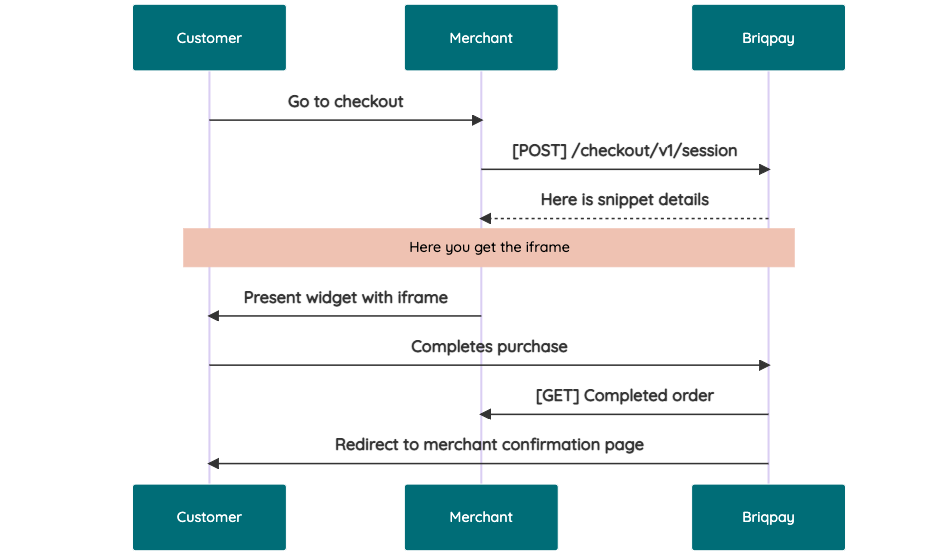 # JavaScript SDK The first step of integration is to add our JS to your site just before closing the ```` tag. This ensures that our JS library is avaliable to load the checkout. ```` Briqpay offers a few methods avaliable through our Javascript SDK. The library is added by our iframe and is avalable on ``window._briqpay`` If you offer the posibility to update the cart or order amonts on the checkout page, the JS library will help you. If your store charges the customer different costs and fees depening on their shipping location, you can listen to the ``addressupdate``event in order to re-calculate the total cost. ```javascript window._briqpay.subscribe('addressupdate', function (data) { console.log(data) }) ``` If your frontend needs to perform an action whe the signup has completed, listen to the ``signup_finalized`` event. ```javascript window._briqpay.subscribe('signup_finalized', function (status) { // redirect or handle status 'success' / 'failure' }) ``` If you allow customers to change the total cart value, you can utilise the JS library to suspend the iframe while you perform a backen update call towards our services. As described below: 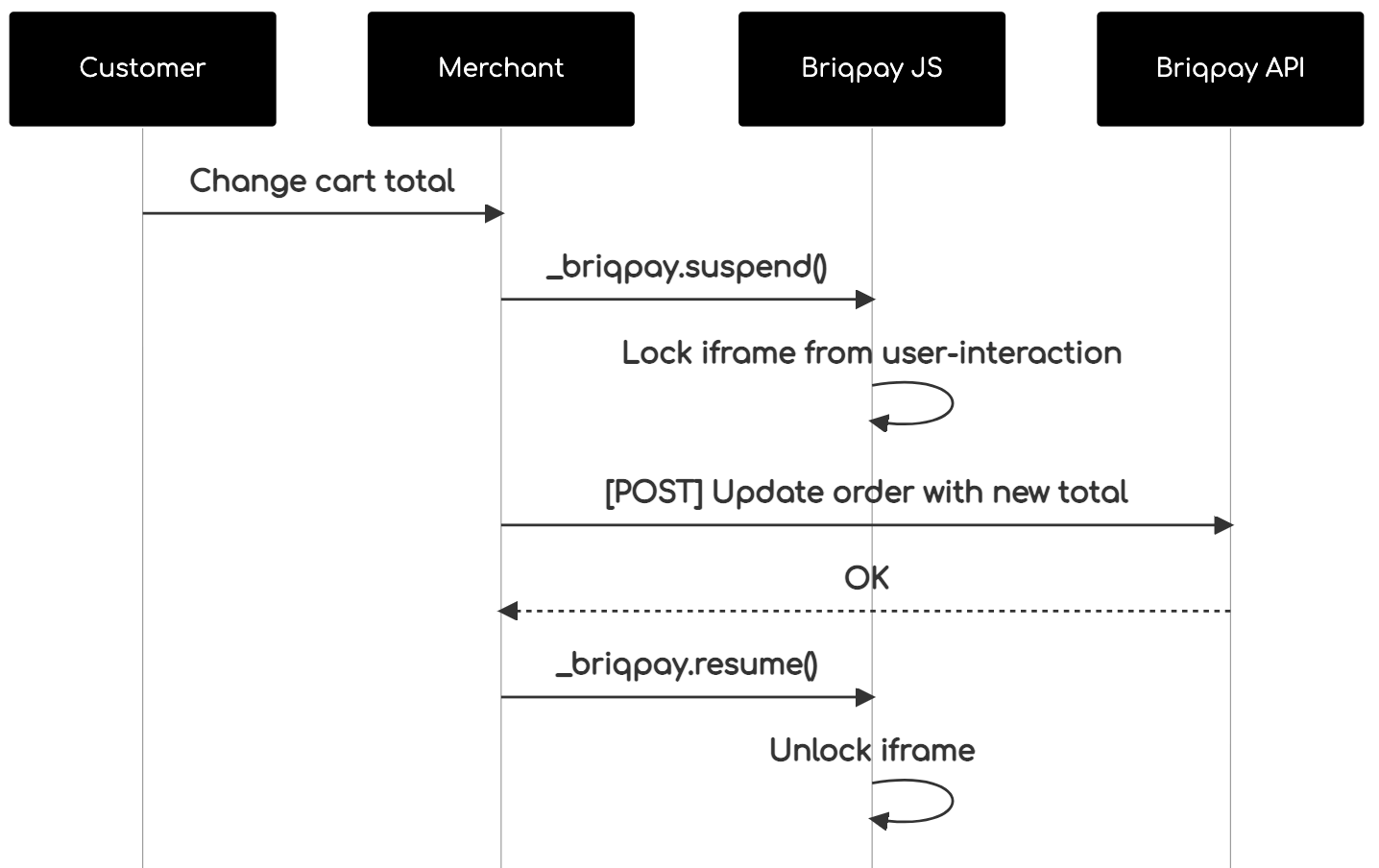 The iframe will auto-resume after 7 seconds if you dont call ``_briqpay.resume()`` before # Test Data In order to verify your integration you will neeed to use test data towards our credit engine. ## Company identication numbers * 1111111111 - To recieve a high credit scoring company ( 100 in rating) * 2222222222 - To test the enviournment with a bad credit scoring company (10 in rating) ## Card details In our playground setup your account is by default setup with a Stripe integration. In order to test out the card form you can use the below card numbers: * 4000002500003155 - To mock 3ds authentication window * 4000000000000069 Charge is declined with an expired_card code. You can use any valid expiry and CVC code # Authentication Briqpay utilizes JWT in order to authenticate calls to our platform. Authentication tokens expire after 48 hours, and at that point you can generate a new token for the given resource using the ``/auth`` endpoint. - Basic Auth - only used on the auth endpoint in order to get the Bearer Token - JWT Bearer Token - All calls towards the API utlizes this method"
jpry/array-defaults
4524 Downloads
Create arrays with default values
dmitrykazak/magento2-custom-option-default-value
389 Downloads
This extension will allow you to set the default of product custom options for Magento 2
soderlind/class-customizer-range-value-control
249 Downloads
WordPress Customizer Range Value Control is a generic range with value control you can use to replace the default range control.
cse/helpers-request
91 Downloads
The helpers allows you to Request processing. Get value for POST/GET/REQUEST method by key and set default value, check exist AJAX, POST and GET method - all this is available in this library.
default-value/akeneo-inline-edit-bundle
55 Downloads
Add ability to enable inline edit for Akeneo PIM product grid
germanow/yii2-active-record-seeder
892 Downloads
Seeds database with test or default values.
yireo/yireo_producttemplates
11 Downloads
Allows for new products to be filled in with default values