Libraries tagged by Response HTTP
lezhnev74/psr-logging-masking-middleware
637 Downloads
A logging middleware for any PSR-7 HTTP client that logs every request/response through a PSR-3 logger, with headers, query args and body keys masked. Built on PSR-7, PSR-17 and PSR-3.
citypay/citypay-api-client-php
437 Downloads
Welcome to the CityPay API, a robust HTTP API payment solution designed for seamless server-to-server transactional processing. Our API facilitates a wide array of payment operations, catering to diverse business needs. Whether you're integrating Internet payments, handling Mail Order/Telephone Order (MOTO) transactions, managing Subscriptions with Recurring and Continuous Authority payments, or navigating the complexities of 3-D Secure authentication, our API is equipped to support your requirements. Additionally, we offer functionalities for Authorisation, Refunding, Pre-Authorisation, Cancellation/Voids, and Completion processing, alongside the capability for tokenised payments. ## Compliance and Security Overview Ensuring the security of payment transactions and compliance with industry standards is paramount. Our API is designed with stringent security measures and compliance protocols to safeguard sensitive information and meet the rigorous requirements of Visa, MasterCard, and the PCI Security Standards Council. ### Key Compliance and Security Measures * **TLS Encryption**: All data transmissions must utilise TLS version 1.2 or higher, employing [strong cryptography](#enabled-tls-ciphers). Our infrastructure strictly enforces this requirement to maintain the integrity and confidentiality of data in transit. We conduct regular scans and assessments of our TLS endpoints to identify and mitigate vulnerabilities. * **Data Storage Prohibitions**: Storing sensitive cardholder data (CHD), such as the card security code (CSC) or primary account number (PAN), is strictly prohibited. Our API is designed to minimize your exposure to sensitive data, thereby reducing your compliance burden. * **Data Masking**: For consumer protection and compliance, full card numbers must not be displayed on receipts or any customer-facing materials. Our API automatically masks PANs, displaying only the last four digits to facilitate safe receipt generation. * **Network Scans**: If your application is web-based, regular scans of your hosting environment are mandatory to identify and rectify potential vulnerabilities. This proactive measure is crucial for maintaining a secure and compliant online presence. * **PCI Compliance**: Adherence to PCI DSS standards is not optional; it's a requirement for operating securely and legally in the payments ecosystem. For detailed information on compliance requirements and resources, please visit the PCI Security Standards Council website [https://www.pcisecuritystandards.org/](https://www.pcisecuritystandards.org/). * **Request Validation**: Our API includes mechanisms to verify the legitimacy of each request, ensuring it pertains to a valid account and originates from a trusted source. We leverage remote IP address verification alongside sophisticated application firewall technologies to thwart a wide array of common security threats. ## Getting Started Before integrating with the CityPay API, ensure your application and development practices align with the outlined compliance and security measures. This preparatory step is crucial for a smooth integration process and the long-term success of your payment processing operations. For further details on API endpoints, request/response formats, and code examples, proceed to the subsequent sections of our documentation. Our aim is to provide you with all the necessary tools and information to integrate our payment processing capabilities seamlessly into your application. Thank you for choosing CityPay API. We look forward to supporting your payment processing needs with our secure, compliant, and versatile API solution.
aporat/push-notifications
196 Downloads
PHP client for Apple Push Notification service (APNs) and Firebase Cloud Messaging (FCM): token-based auth, persistent HTTP/2, typed payloads and normalized responses
ahmedhat/unifonicnextgen
3865 Downloads
## Introduction Send SMS messages using Unifonic Messaging API. Get your dedicated Universal number, and start sending messages today. Unifonic NextGen Restful and HTTP **API's** uses The basic Authentication protocol. All request and response bodies are formatted in JSON. ## Get an account To start using the API you need to send an email to Unifonic to create Appsid for you. ## Base URL All URLs referenced in the documentation have the following base: **basic.unifonic.com** ## Security To ensure privacy we recommend you to use HTTPS for all Unifonic API requests. you can download our HTTPS certificate. [Download] (https://api.unifonic.com/udm/https.zip) ## Formats Unifonic API only supports JSON format. All request must use the Content-type header set to application/json. ## Support We’re here to help! Get in touch with support at and we’ll get back to you as soon as we can or you can contact us throw live chat on our [website] (www.unifonic.com).
paypaplane/svix-client
24740 Downloads
Welcome to the Svix API documentation! Useful links: [Homepage](https://www.svix.com) | [Support email](mailto:[email protected]) | [Blog](https://www.svix.com/blog/) | [Slack Community](https://www.svix.com/slack/) # Introduction This is the reference documentation and schemas for the [Svix webhook service](https://www.svix.com) API. For tutorials and other documentation please refer to [the documentation](https://docs.svix.com). ## Main concepts In Svix you have four important entities you will be interacting with: - `messages`: these are the webhooks being sent. They can have contents and a few other properties. - `application`: this is where `messages` are sent to. Usually you want to create one application for each user on your platform. - `endpoint`: endpoints are the URLs messages will be sent to. Each application can have multiple `endpoints` and each message sent to that application will be sent to all of them (unless they are not subscribed to the sent event type). - `event-type`: event types are identifiers denoting the type of the message being sent. Event types are primarily used to decide which events are sent to which endpoint. ## Authentication Get your authentication token (`AUTH_TOKEN`) from the [Svix dashboard](https://dashboard.svix.com) and use it as part of the `Authorization` header as such: `Authorization: Bearer ${AUTH_TOKEN}`. For more information on authentication, please refer to the [authentication token docs](https://docs.svix.com/api-keys). ## Code samples The code samples assume you already have the respective libraries installed and you know how to use them. For the latest information on how to do that, please refer to [the documentation](https://docs.svix.com/). ## Idempotency Svix supports [idempotency](https://en.wikipedia.org/wiki/Idempotence) for safely retrying requests without accidentally performing the same operation twice. This is useful when an API call is disrupted in transit and you do not receive a response. To perform an idempotent request, pass the idempotency key in the `Idempotency-Key` header to the request. The idempotency key should be a unique value generated by the client. You can create the key in however way you like, though we suggest using UUID v4, or any other string with enough entropy to avoid collisions. Svix's idempotency works by saving the resulting status code and body of the first request made for any given idempotency key for any successful request. Subsequent requests with the same key return the same result. Please note that idempotency is only supported for `POST` requests. ## Cross-Origin Resource Sharing This API features Cross-Origin Resource Sharing (CORS) implemented in compliance with [W3C spec](https://www.w3.org/TR/cors/). And that allows cross-domain communication from the browser. All responses have a wildcard same-origin which makes them completely public and accessible to everyone, including any code on any site.
briqpay/php-sdk
12246 Downloads
This is the API documentation for Briqpay. You can find out more about us and our offering at our website [https://briqpay.com](https://briqpay.com) In order to get credentials to the playgrund API Please register at [https://app.briqpay.com](https://app.briqpay.com) # Introduction Briqpay Checkout is an inline checkout solution for your b2b ecommerce. Briqpay Checkout gives you the flexibility of controlling your payment methods and credit rules while optimizing the UX for your customers # SDKs Briqpay offers standard SDKs to PHP and .NET based on these swagger definitions. You can download them respively or use our swagger defintitions to codegen your own versions. #### For .NET `` Install-Package Briqpay `` #### For PHP `` composer require briqpay/php-sdk `` # Standard use-case As a first step of integration you will need to create a checkout session. \n\nIn this session you provide Briqpay with the basic information necessary. In the response from briqpay you will recieve a htmlsnippet that is to be inserted into your frontend. The snippet provided by briqpay will render an iframe where the user will complete the purchase. Once completed, briqpay will redirect the customer to a confirmation page that you have defined. 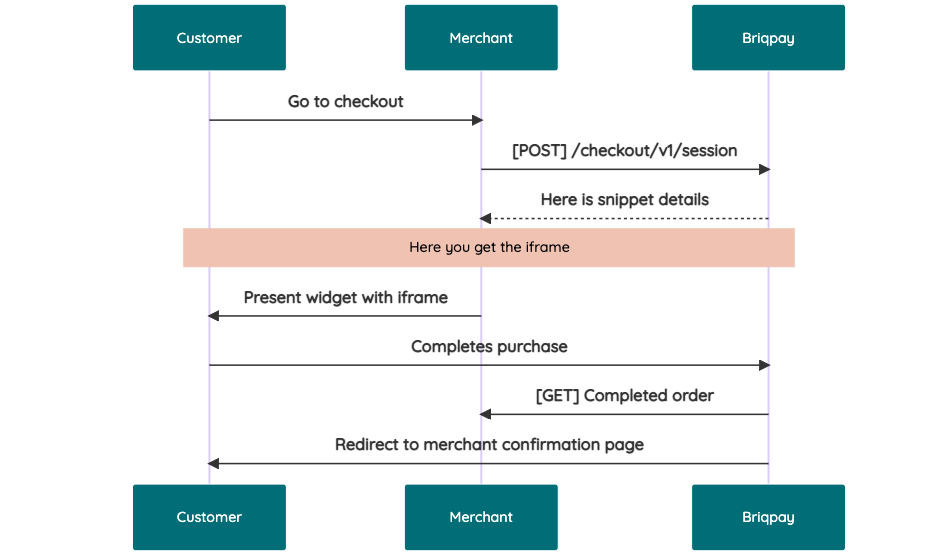 # JavaScript SDK The first step of integration is to add our JS to your site just before closing the ```` tag. This ensures that our JS library is avaliable to load the checkout. ```` Briqpay offers a few methods avaliable through our Javascript SDK. The library is added by our iframe and is avalable on ``window._briqpay`` If you offer the posibility to update the cart or order amonts on the checkout page, the JS library will help you. If your store charges the customer different costs and fees depening on their shipping location, you can listen to the ``addressupdate``event in order to re-calculate the total cost. ```javascript window._briqpay.subscribe('addressupdate', function (data) { console.log(data) }) ``` If your frontend needs to perform an action whe the signup has completed, listen to the ``signup_finalized`` event. ```javascript window._briqpay.subscribe('signup_finalized', function (status) { // redirect or handle status 'success' / 'failure' }) ``` If you allow customers to change the total cart value, you can utilise the JS library to suspend the iframe while you perform a backen update call towards our services. As described below: 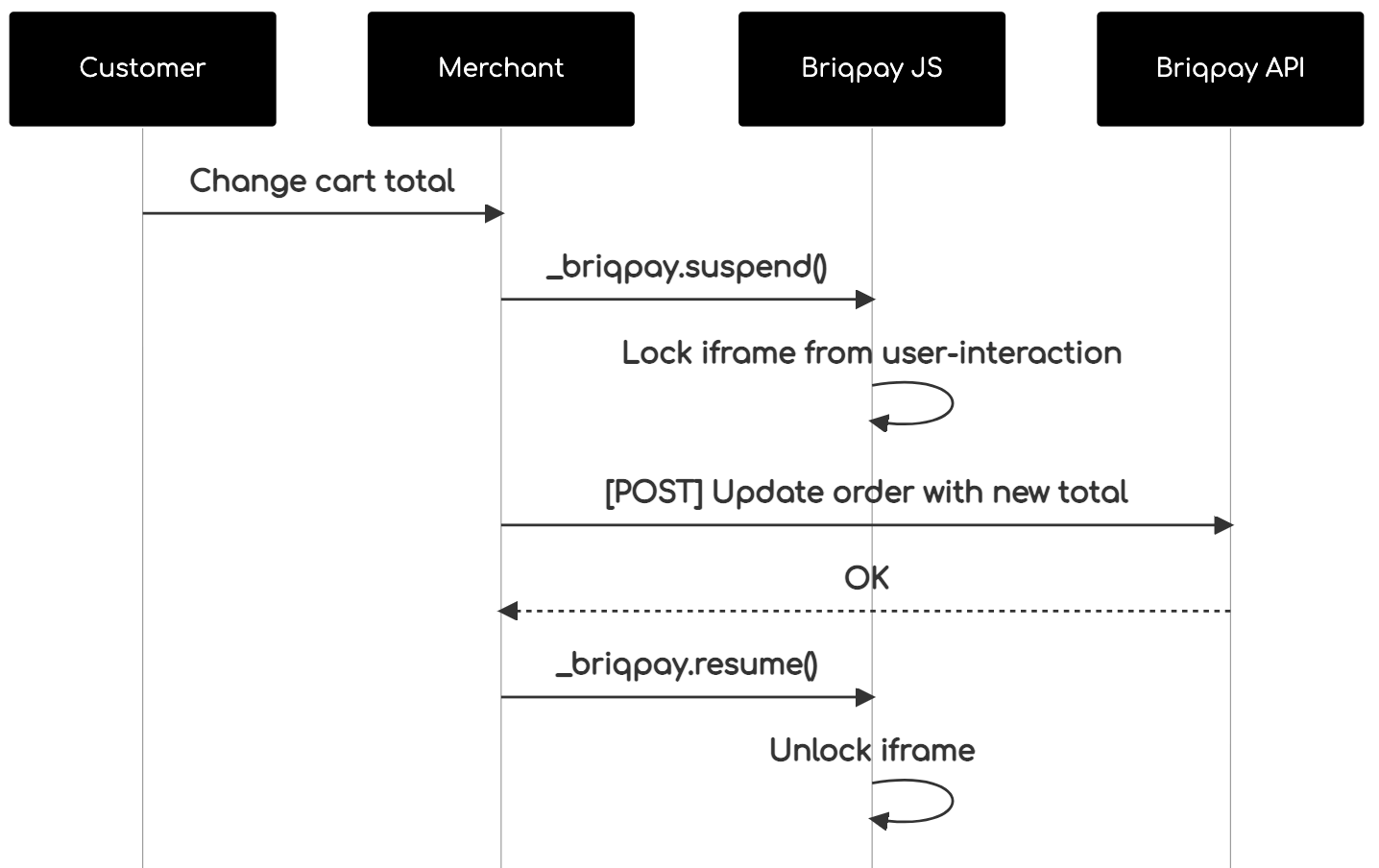 The iframe will auto-resume after 7 seconds if you dont call ``_briqpay.resume()`` before # Test Data In order to verify your integration you will neeed to use test data towards our credit engine. ## Company identication numbers * 1111111111 - To recieve a high credit scoring company ( 100 in rating) * 2222222222 - To test the enviournment with a bad credit scoring company (10 in rating) ## Card details In our playground setup your account is by default setup with a Stripe integration. In order to test out the card form you can use the below card numbers: * 4000002500003155 - To mock 3ds authentication window * 4000000000000069 Charge is declined with an expired_card code. You can use any valid expiry and CVC code # Authentication Briqpay utilizes JWT in order to authenticate calls to our platform. Authentication tokens expire after 48 hours, and at that point you can generate a new token for the given resource using the ``/auth`` endpoint. - Basic Auth - only used on the auth endpoint in order to get the Bearer Token - JWT Bearer Token - All calls towards the API utlizes this method"
massfice/response-status
152 Downloads
Package contains response-status class, that contains info about validation status, response http code, errors array, messages, etc. Project for my diploma.
diegospm/http-provider-interfaces
129 Downloads
Interfaces for client and response HTTP
fabrizio-cafolla/response-http
171 Downloads
Response service for Symfony & Laravel/Lumen Framework.
broosaction/php-https
7 Downloads
Broos Action Request Response Https Library
wilycode/http-response
14 Downloads
Typed PSR-7 response factory for HTML, JSON, redirects and empty responses.
webservco/http-response-service
446 Downloads
A PHP component/library. List of HTTP status codes, with a validator for them.
stackmasteraliza/laravel-api-response
57 Downloads
A clean, fluent, and consistent API response builder for Laravel 10/11/12. Features standardized JSON responses, automatic pagination metadata, built-in exception handling, validation error formatting, and a convenient trait for controllers.
sm-sandy/api-response
144 Downloads
The ApiResponse package is a simple yet powerful Laravel package designed to streamline the process of formatting API responses. It provides a convenient way to structure and return JSON responses in a consistent format for both success and error scenarios.
sevaske/laravel-api-response
28 Downloads
The package for building clean, consistent, and predictable JSON API responses in laravel applications.