Libraries tagged by api responder
nylo/dejajson
261 Downloads
Give zlib déjà vu: compress Laravel JSON responses against a dictionary trained on your own API, cutting payloads far below what gzip can reach. Adds response()->dejaJson() and a drop-in middleware; pairs with the dejajson Dio interceptor for Flutter.
nogrod/tyre24-seller-php-sdk
580 Downloads
## API Versioning We're constantly updating and improving the API, and while we try to ensure backwards compatibility, there's always a chance that we'll introduce a change that affects the way your app works. To get around any problems that this might cause, we recommend that you include the Accept header with every API request that you make. This header enables you to target your request to a particular version of the API. It looks like this in HTTP: ```text Accept: application/vnd.saitowag.api+json;version={version_number} ``` Normally, you set the value of the placeholder to the current version of the API. But if you're troubleshooting your app, and you know that an older version of the API works perfectly, say version 1.0, you'd substitute 1.0 for the placeholder value. The API then handles the request as if it were for version 1.0, and your app goes back to working properly. ### Example of an error with invalid `ACCEPT` header. The `HTTP status code` in case of an invalid `ACCEPT` header will be `400 Bad Request` and the following response will be returned. ```json { "data": [ { "error_code": "ERR_ACCEPT_HEADER_NOT_VALID", "error_message": "Accept header is not valid or not set." } ] } ``` ### Unexpected Error If an unexpected error occours, a so called Error General will be returned. The `HTTP status code` in case of an invalid `ACCEPT` header will be `500` and the following response will be returned. ```json { "data": [ { "error_code": "ERR_GENERAL", "error_message": "An unexpected error has occurred. If this problem persists, please contact our support." } ] } ``` ### Invalid Endpoint Error Any call to a non-existing API endpoint (i.e. wrong route) will return a response with `HTTP status code` `404` and the following response body: ```json { "data": [ { "error_code": "ERR_GENERAL_INVALID_ENDPOINT", "error_message": "The requested endpoint does not exist." } ] } ``` Please, note that this error is returned also when a request parameter, part of a valid route, is not well formed. For example, a call to a route that contains a wrong order id (i.e. it does not meet the accepted order id pattern - e.g. 123456789PAC instead of PAC123456789) will return the error just mentioned, as the route is considered as badly formed. In conclusion, please pay special attention to all those routes that have request parameters with specific pattern requirements. ### Shipping Method IDs These ids may not be available in all the countries. | ID | Name | | --- | --- | | 1 | Standard `Standard` | | 2 | Self-collection `Selbstabholung` | | 3 | Express morning (truck) `Express-Morgen (LKW)` | | 4 | Express Today (Truck) `Express-Heute (LKW)` | | 5 | Express morning (package forwarding) `Express-Morgen (Packet Spedition)` | | 7 | Express-now | ### Payment Method IDs These ids may not be available in all the countries. | ID | Name | | --- | --- | | 1 | SEPA Direct Debit `SEPA-Lastschrift` | | 2 | Prepayment `Vorkasse` | | 3 | Cash on delivery `Nachnahme` | | 4 | PayPal/Credit Card `PayPal/Kreditkarte` | | 5 | open payment method `offene Zahlungsart` | | 7 | Invoice(8 days payment term) `Rechnung(8 Tage Zahlungsziel)` | | 8 | open payment method (SEPA) `offene Zahlungsart (SEPA)` | ## Query String Filters Query String Filters | Operator | Full Name | Description | Example | | ------ | ------ | ------ | ------ | | eq | Equal | Used to narrow down the result of a query to some specific value, for specified field. It adds the "**=**" symbol to the SQL query. Eg. `{url}?filter[{alias_name}]=eq;11` will result in the following sql: `SELECT {field_name} AS {alias_name} FROM {table_name} WHERE {alias_name} = 11` | integer: `{url}?filter[id]=eq;21`float: `{url}?filter[average]=eq;3.7`string: `{url}?filter[free_text]=eq;apple`Date: `{url}?filter[birthday]=eq;2020-06-03`DateTime: `{url}?filter[created_at]=eq;2020-06-03 14:32:32`boolean: `{url}?filter[is_active]=eq;1` | | neq | Not equal | Used to exclude the value from a query result. It adds the "****" symbol to the SQL query. Eg. `{url}?filter[{alias_name}]=neq;11` will result in the following sql: `SELECT {field_name} AS {alias_name} FROM {table_name} WHERE {alias_name} 11` | integer: `{url}?filter[id]=neq;21`float: `{url}?filter[average]=neq;3.7`string: `{url}?filter[free_text]=neq;apple`Date: `{url}?filter[birthday]=neq;2020-06-03`DateTime: `{url}?filter[created_at]=neq;2020-06-03 14:32:32`boolean: `{url}?filter[is_active]=neq;1` | | gt | Greater than | Used to reduce fetched values to those greater than the one provided in a query string. It adds the "**>**" symbol to the SQL query. Eg. `{url}?filter[{alias_name}]=gt;11` will result in the following sql: `SELECT {field_name} AS {alias_name} FROM {table_name} WHERE {alias_name} > 11` | integer: `{url}?filter[id]=gt;21`float: `{url}?filter[average]=gt;3.7`Date: `{url}?filter[birthday]=gt;2020-06-03`DateTime: `{url}?filter[created_at]=gt;2020-06-03 14:32:32` | | gte | Greater than or equal | Used to reduce fetched values to those greater than or equal to the one provided in a query string. It adds the "**>=**" symbol to the SQL query. Eg. `{url}?filter[{alias_name}]=gte;11` will result in the following sql: `SELECT {field_name} AS {alias_name} FROM {table_name} WHERE {alias_name} >= 11` | integer: `{url}?filter[id]=gte;21`float: `{url}?filter[average]=gte;3.7`Date: `{url}?filter[birthday]=gte;2020-06-03`DateTime: `{url}?filter[created_at]=gte;2020-06-03 14:32:32` | | lt | Less than | Used to reduce fetched values to those less than provided in a query string. It adds the "**
nogrod/tyre24-common-php-sdk
576 Downloads
## API Versioning We're constantly updating and improving the API, and while we try to ensure backwards compatibility, there's always a chance that we'll introduce a change that affects the way your app works. To get around any problems that this might cause, we recommend that you include the Accept header with every API request that you make. This header enables you to target your request to a particular version of the API. It looks like this in HTTP: ```text Accept: application/vnd.saitowag.api+json;version={version_number} ``` Normally, you set the value of the placeholder to the current version of the API. But if you're troubleshooting your app, and you know that an older version of the API works perfectly, say version 1.0, you'd substitute 1.0 for the placeholder value. The API then handles the request as if it were for version 1.0, and your app goes back to working properly. ### Example of an error with invalid `ACCEPT` header. The `HTTP status code` in case of an invalid `ACCEPT` header will be `400 Bad Request` and the following response will be returned. ```json { "data": [ { "error_code": "ERR_ACCEPT_HEADER_NOT_VALID", "error_message": "Accept header is not valid or not set." } ] } ``` ### Unexpected Error If an unexpected error occours, a so called Error General will be returned. The `HTTP status code` in case of an invalid `ACCEPT` header will be `500` and the following response will be returned. ```json { "data": [ { "error_code": "ERR_GENERAL", "error_message": "An unexpected error has occurred. If this problem persists, please contact our support." } ] } ``` ### Invalid Endpoint Error Any call to a non-existing API endpoint (i.e. wrong route) will return a response with `HTTP status code` `404` and the following response body: ```json { "data": [ { "error_code": "ERR_GENERAL_INVALID_ENDPOINT", "error_message": "The requested endpoint does not exist." } ] } ``` Please, note that this error is returned also when a request parameter, part of a valid route, is not well formed. For example, a call to a route that contains a wrong order id (i.e. it does not meet the accepted order id pattern - e.g. 123456789PAC instead of PAC123456789) will return the error just mentioned, as the route is considered as badly formed. In conclusion, please pay special attention to all those routes that have request parameters with specific pattern requirements. ### Shipping Method IDs These ids may not be available in all the countries. | ID | Name | | --- | --- | | 1 | Standard `Standard` | | 2 | Self-collection `Selbstabholung` | | 3 | Express morning (truck) `Express-Morgen (LKW)` | | 4 | Express Today (Truck) `Express-Heute (LKW)` | | 5 | Express morning (package forwarding) `Express-Morgen (Packet Spedition)` | | 7 | Express-now | ### Payment Method IDs These ids may not be available in all the countries. | ID | Name | | --- | --- | | 1 | SEPA Direct Debit `SEPA-Lastschrift` | | 2 | Prepayment `Vorkasse` | | 3 | Cash on delivery `Nachnahme` | | 4 | PayPal/Credit Card `PayPal/Kreditkarte` | | 5 | open payment method `offene Zahlungsart` | | 7 | Invoice(8 days payment term) `Rechnung(8 Tage Zahlungsziel)` | | 8 | open payment method (SEPA) `offene Zahlungsart (SEPA)` | ## Query String Filters Query String Filters | Operator | Full Name | Description | Example | | ------ | ------ | ------ | ------ | | eq | Equal | Used to narrow down the result of a query to some specific value, for specified field. It adds the "**=**" symbol to the SQL query. Eg. `{url}?filter[{alias_name}]=eq;11` will result in the following sql: `SELECT {field_name} AS {alias_name} FROM {table_name} WHERE {alias_name} = 11` | integer: `{url}?filter[id]=eq;21`float: `{url}?filter[average]=eq;3.7`string: `{url}?filter[free_text]=eq;apple`Date: `{url}?filter[birthday]=eq;2020-06-03`DateTime: `{url}?filter[created_at]=eq;2020-06-03 14:32:32`boolean: `{url}?filter[is_active]=eq;1` | | neq | Not equal | Used to exclude the value from a query result. It adds the "****" symbol to the SQL query. Eg. `{url}?filter[{alias_name}]=neq;11` will result in the following sql: `SELECT {field_name} AS {alias_name} FROM {table_name} WHERE {alias_name} 11` | integer: `{url}?filter[id]=neq;21`float: `{url}?filter[average]=neq;3.7`string: `{url}?filter[free_text]=neq;apple`Date: `{url}?filter[birthday]=neq;2020-06-03`DateTime: `{url}?filter[created_at]=neq;2020-06-03 14:32:32`boolean: `{url}?filter[is_active]=neq;1` | | gt | Greater than | Used to reduce fetched values to those greater than the one provided in a query string. It adds the "**>**" symbol to the SQL query. Eg. `{url}?filter[{alias_name}]=gt;11` will result in the following sql: `SELECT {field_name} AS {alias_name} FROM {table_name} WHERE {alias_name} > 11` | integer: `{url}?filter[id]=gt;21`float: `{url}?filter[average]=gt;3.7`Date: `{url}?filter[birthday]=gt;2020-06-03`DateTime: `{url}?filter[created_at]=gt;2020-06-03 14:32:32` | | gte | Greater than or equal | Used to reduce fetched values to those greater than or equal to the one provided in a query string. It adds the "**>=**" symbol to the SQL query. Eg. `{url}?filter[{alias_name}]=gte;11` will result in the following sql: `SELECT {field_name} AS {alias_name} FROM {table_name} WHERE {alias_name} >= 11` | integer: `{url}?filter[id]=gte;21`float: `{url}?filter[average]=gte;3.7`Date: `{url}?filter[birthday]=gte;2020-06-03`DateTime: `{url}?filter[created_at]=gte;2020-06-03 14:32:32` | | lt | Less than | Used to reduce fetched values to those less than provided in a query string. It adds the "**
nogrod/dhl-retoure-php-sdk
649 Downloads
# Introduction ## Overview Note: This is the specification of the DP-DHL Group Parcel DE Returns API. This web service allows business customers to create return labels on demand. # Scenarios ## Main Scenario: Creating a returnlabel This is achieved by posting a return order to the URI '/rest/orders'. The service will respond with a return label. ## Querying to get receiver locations The single scenario supported by this service is the determination of the receiver's location. This is achieved by getting a location to the URI '/rest/locations'. The service will respond with a Receiver. # Technical Note on Authorization This API supports __two alternative ways__ to authorize yourself: 1. Combination of Apikey and Basic Authentication which you can provide with every call. 2. OAuth2 Password Flow: After having obtained your access token once, you provide this token as bearer token. You can try it out here. More details can be found when clicking on "Authorize".
mnavarrocarter/php-fetch
215 Downloads
A simple, type-safe, zero dependency port of the javascript fetch WebApi for PHP
macpaw/behat-openapi-psr7-validator
1618 Downloads
Behat extension for automatic OpenAPI validation of HTTP requests/responses using league/openapi-psr7-validator
kyzegs/guzzle-rate-limit-middleware
1276 Downloads
A configurable Guzzle middleware for rate limiting HTTP requests based on response headers
invoicetronic/php-sdk
175 Downloads
The [Invoicetronic API][2] is a RESTful service that allows you to send and receive invoices through the Italian [Servizio di Interscambio (SDI)][1], or Interchange Service. The API is designed to be simple and easy to use, abstracting away SDI complexity while providing complete control over the invoice send/receive process. It provides advanced features as encryption at rest, multi-language pre-flight invoice validation, multiple upload formats, webhooks, event logging, client SDKs, and CLI tools. For more information, see [Invoicetronic website][2] ## Before you start For the full integration guide, tutorials, SDKs and quickstarts, see the **[Documentation](https://invoicetronic.com/en/docs/)**. A few cross-cutting topics worth knowing before integrating: - **[Prerequisites](https://invoicetronic.com/en/docs/prerequisites/)** — what you need to start in Sandbox and what's required to move to production. - **[API Keys](https://invoicetronic.com/en/docs/apikeys/)** — how `ik_live_` and `ik_test_` keys select the environment. - **[Sandbox](https://invoicetronic.com/en/docs/sandbox/)** — free test environment that mirrors the live workflow, with no credits consumed. - **[Rate Limiting](https://invoicetronic.com/en/docs/ratelimiting/)** — per-second, per-minute and per-day limits; how to handle `429 Too Many Requests`. - **[Pagination](https://invoicetronic.com/en/docs/pagination/)** — `page` and `page_size` parameters and the `Invoicetronic-Total-Count` response header. - **[CORS](https://invoicetronic.com/en/docs/cors/)** — calling the API from the browser; allowed origins are configured per key. - **[Webhooks](https://invoicetronic.com/en/docs/webhooks/)** — real-time event notifications with HMAC-SHA256 signature validation. - **[Localization](https://invoicetronic.com/en/docs/accept-language/)** — use the `Accept-Language` header to receive error messages in Italian, English or German. [1]: https://www.fatturapa.gov.it/it/sistemainterscambio/cose-il-sdi/ [2]: https://invoicetronic.com/
inda-hr/php_sdk
1381 Downloads
# Introduction **INDA (INtelligent Data Analysis)** is an [Intervieweb](https://www.intervieweb.it/hrm/) AI solution provided as a RESTful API. The INDA pricing model is *credits-based*, which means that a certain number of credits is associated to each API request. Hence, users have to purchase a certain amount of credits (established according to their needs) which will be reduced at each API call. INDA accepts and processes a user's request only if their credits quota is grater than - or, at least, equal to - the number of credits required by that request. To obtain further details on the pricing, please visit our [site](https://inda.ai) or contact us. INDA HR embraces a wide range of functionalities to manage the main elements of a recruitment process: + [**candidate**](https://api.inda.ai/hr/docs/v2/#tag/Resume-Management) (hereafter also referred to as **resume** or **applicant**), or rather a person looking for a job; + [**job advertisement**](https://api.inda.ai/hr/docs/v2/#tag/JobAd-Management) (hereafter also referred to as **job ad**), which is a document that collects all the main information and details about a job vacancy; + [**application**](https://api.inda.ai/hr/docs/v2/#tag/Application-Management), that binds candidates to job ads; it is generated whenever a candidate applies for a job. Each of them has a specific set of methods that grants users the ability to create, read, update and delete the relative documents, plus some special features based on AI approaches (such as *document parsing* or *semantic search*). They can be explored in their respective sections. Data about the listed document types can be enriched by connecting them to other INDA supported entities, such as [**companies**](https://api.inda.ai/hr/docs/v2/#tag/Company-Management) and [**universities**](https://api.inda.ai/hr/docs/v2/#tag/Universities), so that recruiters may get a better and more detailed idea on the candidates' experiences and acquired skills. All the functionalities mentioned above are meant to help recruiters during the talent acquisition process, by exploiting the power of AI systems. Among the advantages a recruiter has by using this kind of systems, tackling the bias problem is surely one of the most relevant. Bias in recruitment is a serious issue that affect both recruiters and candidates, since it may cause wrong hiring decisions. As we care a lot about this problem, we are constantly working on reduce the bias in original data so that INDA results may be as fair as possible. As of now, in order to tackle the bias issue, INDA automatically ignores specific fields (such as name, gender, age and nationality) during the initial processing of each candidate data. Furthermore, we decided to let users collect data of various types, including personal or sensitive details, but we do not allow their usage if it is different from statistical purposes; our aim is to discourage recruiters from focusing on candidates' personal information, and to put their attention on the candidate's skills and abilities. We want to help recruiters to prevent any kind of bias while searching for the most valuable candidates they really need. The following documentation is addressed both to developers, in order to provide all technical details for INDA integration, and to managers, to guide them in the exploration of the implementation possibilities. The host of the API is [https://api.inda.ai/hr/v2/](https://api.inda.ai/hr/v2/). We recommend to check the API version and build (displayed near the documentation title). You can contact us at [email protected] in case of problems, suggestions, or particular needs. The search panel on the left can be used to navigate through the documentation and provides an overview of the API structure. On the right, you can find (*i*) the url of the method, (*ii*) an example of request body (if present), and (*iii*) an example of response for each response code. Finally, in the central section of each API method, you can find (*i*) a general description of the purpose of the method, (*ii*) details on parameters and request body schema (if present), and (*iii*) details on response schema, error models, and error codes.
icanboogie/http
7304 Downloads
Provides an API to handle HTTP requests.
hamburgscleanest/laravel-guzzle-throttle
14251 Downloads
A Laravel wrapper for https://github.com/hamburgscleanest/guzzle-advanced-throttle.
hamburgscleanest/guzzle-advanced-throttle
33449 Downloads
A Guzzle middleware that can throttle requests according to (multiple) defined rules. It is also possible to define a caching strategy, e.g. get response from cache when rate limit is exceeded or always get cached value to spare your rate limits.
creatissimo/dhl-de-retoure
117 Downloads
# Introduction ## Overview Note: This is the specification of the DP-DHL Group Parcel DE Returns API. This web service allows business customers to create return labels on demand. # Scenarios ## Main Scenario: Creating a returnlabel This is achieved by posting a return order to the URI '/rest/orders'. The service will respond with a return label. ## Querying to get receiver locations The single scenario supported by this service is the determination of the receiver's location. This is achieved by getting a location to the URI '/rest/locations'. The service will respond with a Receiver. # Technical Note on Authorization This API supports __two alternative ways__ to authorize yourself: 1. Combination of Apikey and Basic Authentication which you can provide with every call. 2. OAuth2 Password Flow: After having obtained your access token once, you provide this token as bearer token. You can try it out here. More details can be found when clicking on "Authorize".
clickandmortar/openrouter-php-client
935 Downloads
PHP SDK for OpenRouter with typed request/response value objects, SSE streaming, and PSR-18 HTTP transport.
briqpay/php-sdk
12100 Downloads
This is the API documentation for Briqpay. You can find out more about us and our offering at our website [https://briqpay.com](https://briqpay.com) In order to get credentials to the playgrund API Please register at [https://app.briqpay.com](https://app.briqpay.com) # Introduction Briqpay Checkout is an inline checkout solution for your b2b ecommerce. Briqpay Checkout gives you the flexibility of controlling your payment methods and credit rules while optimizing the UX for your customers # SDKs Briqpay offers standard SDKs to PHP and .NET based on these swagger definitions. You can download them respively or use our swagger defintitions to codegen your own versions. #### For .NET `` Install-Package Briqpay `` #### For PHP `` composer require briqpay/php-sdk `` # Standard use-case As a first step of integration you will need to create a checkout session. \n\nIn this session you provide Briqpay with the basic information necessary. In the response from briqpay you will recieve a htmlsnippet that is to be inserted into your frontend. The snippet provided by briqpay will render an iframe where the user will complete the purchase. Once completed, briqpay will redirect the customer to a confirmation page that you have defined. 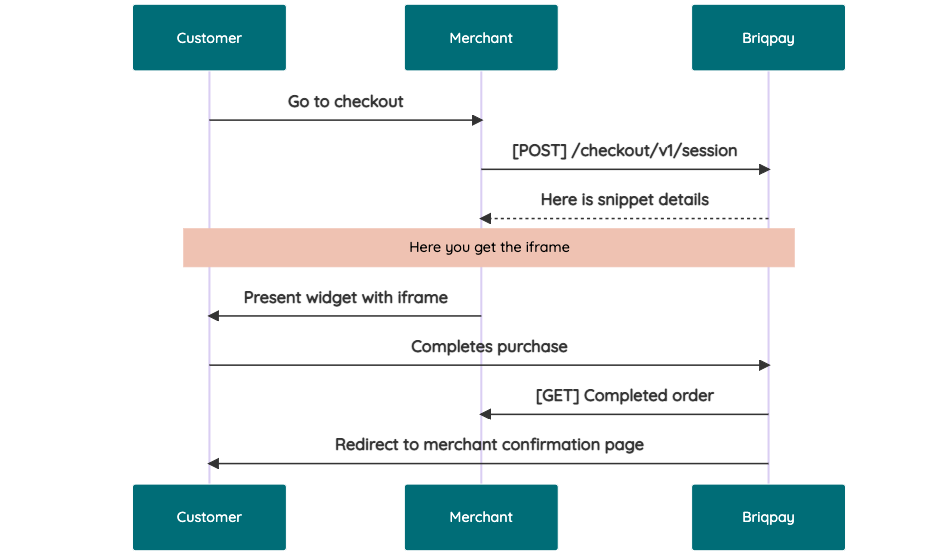 # JavaScript SDK The first step of integration is to add our JS to your site just before closing the ```` tag. This ensures that our JS library is avaliable to load the checkout. ```` Briqpay offers a few methods avaliable through our Javascript SDK. The library is added by our iframe and is avalable on ``window._briqpay`` If you offer the posibility to update the cart or order amonts on the checkout page, the JS library will help you. If your store charges the customer different costs and fees depening on their shipping location, you can listen to the ``addressupdate``event in order to re-calculate the total cost. ```javascript window._briqpay.subscribe('addressupdate', function (data) { console.log(data) }) ``` If your frontend needs to perform an action whe the signup has completed, listen to the ``signup_finalized`` event. ```javascript window._briqpay.subscribe('signup_finalized', function (status) { // redirect or handle status 'success' / 'failure' }) ``` If you allow customers to change the total cart value, you can utilise the JS library to suspend the iframe while you perform a backen update call towards our services. As described below: 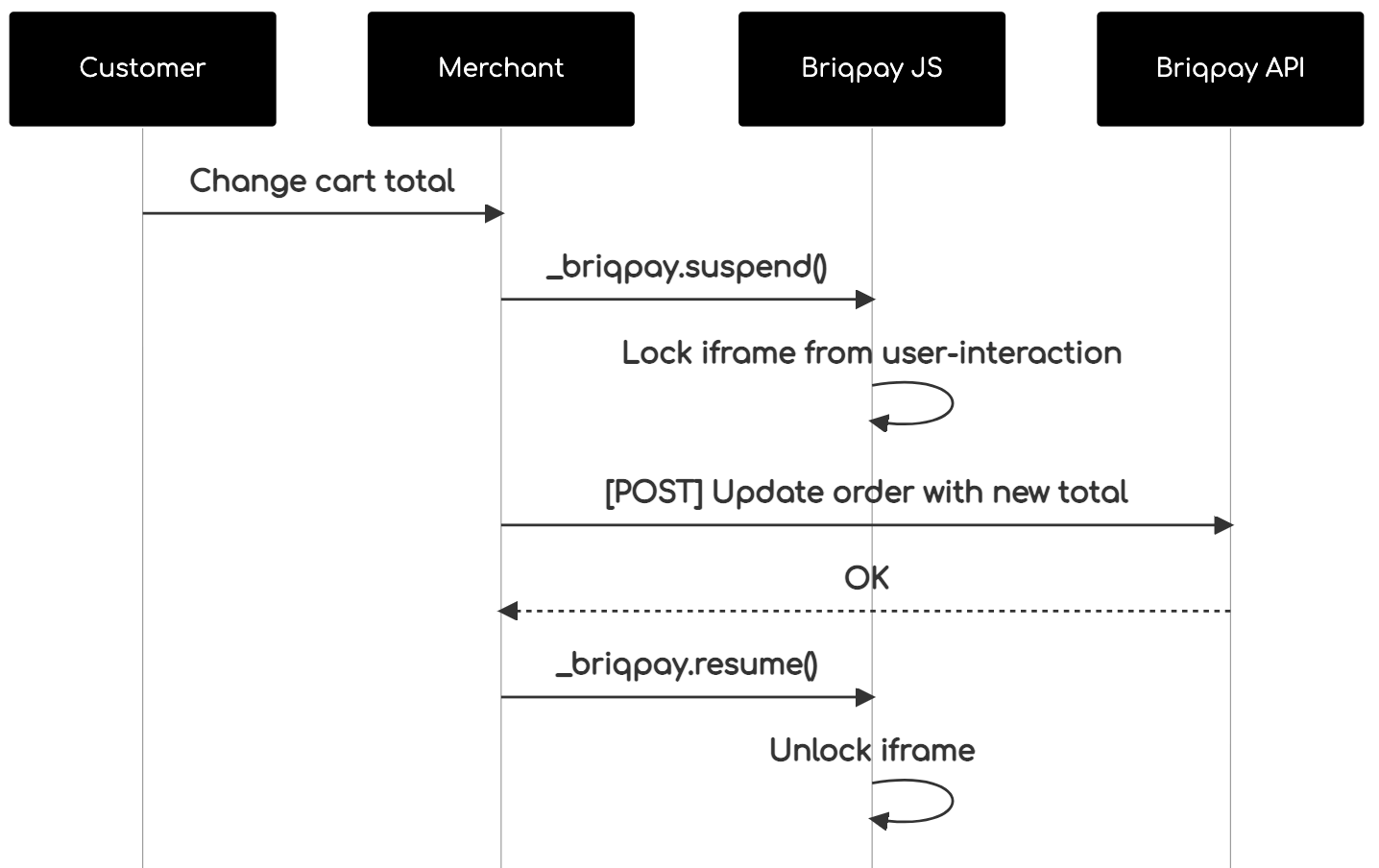 The iframe will auto-resume after 7 seconds if you dont call ``_briqpay.resume()`` before # Test Data In order to verify your integration you will neeed to use test data towards our credit engine. ## Company identication numbers * 1111111111 - To recieve a high credit scoring company ( 100 in rating) * 2222222222 - To test the enviournment with a bad credit scoring company (10 in rating) ## Card details In our playground setup your account is by default setup with a Stripe integration. In order to test out the card form you can use the below card numbers: * 4000002500003155 - To mock 3ds authentication window * 4000000000000069 Charge is declined with an expired_card code. You can use any valid expiry and CVC code # Authentication Briqpay utilizes JWT in order to authenticate calls to our platform. Authentication tokens expire after 48 hours, and at that point you can generate a new token for the given resource using the ``/auth`` endpoint. - Basic Auth - only used on the auth endpoint in order to get the Bearer Token - JWT Bearer Token - All calls towards the API utlizes this method"