Libraries tagged by api response
nylo/smalljson
119 Downloads
Shrink Laravel JSON responses with a compact structural encoding and optional deflate. Adds response()->smallJson() and a drop-in middleware; pairs with the smalljson Dio interceptor for Flutter.
nylo/dejajson
105 Downloads
Give zlib déjà vu: compress Laravel JSON responses against a dictionary trained on your own API, cutting payloads far below what gzip can reach. Adds response()->dejaJson() and a drop-in middleware; pairs with the dejajson Dio interceptor for Flutter.
nogrod/tyre24-seller-php-sdk
412 Downloads
## API Versioning We're constantly updating and improving the API, and while we try to ensure backwards compatibility, there's always a chance that we'll introduce a change that affects the way your app works. To get around any problems that this might cause, we recommend that you include the Accept header with every API request that you make. This header enables you to target your request to a particular version of the API. It looks like this in HTTP: ```text Accept: application/vnd.saitowag.api+json;version={version_number} ``` Normally, you set the value of the placeholder to the current version of the API. But if you're troubleshooting your app, and you know that an older version of the API works perfectly, say version 1.0, you'd substitute 1.0 for the placeholder value. The API then handles the request as if it were for version 1.0, and your app goes back to working properly. ### Example of an error with invalid `ACCEPT` header. The `HTTP status code` in case of an invalid `ACCEPT` header will be `400 Bad Request` and the following response will be returned. ```json { "data": [ { "error_code": "ERR_ACCEPT_HEADER_NOT_VALID", "error_message": "Accept header is not valid or not set." } ] } ``` ### Unexpected Error If an unexpected error occours, a so called Error General will be returned. The `HTTP status code` in case of an invalid `ACCEPT` header will be `500` and the following response will be returned. ```json { "data": [ { "error_code": "ERR_GENERAL", "error_message": "An unexpected error has occurred. If this problem persists, please contact our support." } ] } ``` ### Invalid Endpoint Error Any call to a non-existing API endpoint (i.e. wrong route) will return a response with `HTTP status code` `404` and the following response body: ```json { "data": [ { "error_code": "ERR_GENERAL_INVALID_ENDPOINT", "error_message": "The requested endpoint does not exist." } ] } ``` Please, note that this error is returned also when a request parameter, part of a valid route, is not well formed. For example, a call to a route that contains a wrong order id (i.e. it does not meet the accepted order id pattern - e.g. 123456789PAC instead of PAC123456789) will return the error just mentioned, as the route is considered as badly formed. In conclusion, please pay special attention to all those routes that have request parameters with specific pattern requirements. ### Shipping Method IDs These ids may not be available in all the countries. | ID | Name | | --- | --- | | 1 | Standard `Standard` | | 2 | Self-collection `Selbstabholung` | | 3 | Express morning (truck) `Express-Morgen (LKW)` | | 4 | Express Today (Truck) `Express-Heute (LKW)` | | 5 | Express morning (package forwarding) `Express-Morgen (Packet Spedition)` | | 7 | Express-now | ### Payment Method IDs These ids may not be available in all the countries. | ID | Name | | --- | --- | | 1 | SEPA Direct Debit `SEPA-Lastschrift` | | 2 | Prepayment `Vorkasse` | | 3 | Cash on delivery `Nachnahme` | | 4 | PayPal/Credit Card `PayPal/Kreditkarte` | | 5 | open payment method `offene Zahlungsart` | | 7 | Invoice(8 days payment term) `Rechnung(8 Tage Zahlungsziel)` | | 8 | open payment method (SEPA) `offene Zahlungsart (SEPA)` | ## Query String Filters Query String Filters | Operator | Full Name | Description | Example | | ------ | ------ | ------ | ------ | | eq | Equal | Used to narrow down the result of a query to some specific value, for specified field. It adds the "**=**" symbol to the SQL query. Eg. `{url}?filter[{alias_name}]=eq;11` will result in the following sql: `SELECT {field_name} AS {alias_name} FROM {table_name} WHERE {alias_name} = 11` | integer: `{url}?filter[id]=eq;21`float: `{url}?filter[average]=eq;3.7`string: `{url}?filter[free_text]=eq;apple`Date: `{url}?filter[birthday]=eq;2020-06-03`DateTime: `{url}?filter[created_at]=eq;2020-06-03 14:32:32`boolean: `{url}?filter[is_active]=eq;1` | | neq | Not equal | Used to exclude the value from a query result. It adds the "****" symbol to the SQL query. Eg. `{url}?filter[{alias_name}]=neq;11` will result in the following sql: `SELECT {field_name} AS {alias_name} FROM {table_name} WHERE {alias_name} 11` | integer: `{url}?filter[id]=neq;21`float: `{url}?filter[average]=neq;3.7`string: `{url}?filter[free_text]=neq;apple`Date: `{url}?filter[birthday]=neq;2020-06-03`DateTime: `{url}?filter[created_at]=neq;2020-06-03 14:32:32`boolean: `{url}?filter[is_active]=neq;1` | | gt | Greater than | Used to reduce fetched values to those greater than the one provided in a query string. It adds the "**>**" symbol to the SQL query. Eg. `{url}?filter[{alias_name}]=gt;11` will result in the following sql: `SELECT {field_name} AS {alias_name} FROM {table_name} WHERE {alias_name} > 11` | integer: `{url}?filter[id]=gt;21`float: `{url}?filter[average]=gt;3.7`Date: `{url}?filter[birthday]=gt;2020-06-03`DateTime: `{url}?filter[created_at]=gt;2020-06-03 14:32:32` | | gte | Greater than or equal | Used to reduce fetched values to those greater than or equal to the one provided in a query string. It adds the "**>=**" symbol to the SQL query. Eg. `{url}?filter[{alias_name}]=gte;11` will result in the following sql: `SELECT {field_name} AS {alias_name} FROM {table_name} WHERE {alias_name} >= 11` | integer: `{url}?filter[id]=gte;21`float: `{url}?filter[average]=gte;3.7`Date: `{url}?filter[birthday]=gte;2020-06-03`DateTime: `{url}?filter[created_at]=gte;2020-06-03 14:32:32` | | lt | Less than | Used to reduce fetched values to those less than provided in a query string. It adds the "**
nogrod/tyre24-common-php-sdk
408 Downloads
## API Versioning We're constantly updating and improving the API, and while we try to ensure backwards compatibility, there's always a chance that we'll introduce a change that affects the way your app works. To get around any problems that this might cause, we recommend that you include the Accept header with every API request that you make. This header enables you to target your request to a particular version of the API. It looks like this in HTTP: ```text Accept: application/vnd.saitowag.api+json;version={version_number} ``` Normally, you set the value of the placeholder to the current version of the API. But if you're troubleshooting your app, and you know that an older version of the API works perfectly, say version 1.0, you'd substitute 1.0 for the placeholder value. The API then handles the request as if it were for version 1.0, and your app goes back to working properly. ### Example of an error with invalid `ACCEPT` header. The `HTTP status code` in case of an invalid `ACCEPT` header will be `400 Bad Request` and the following response will be returned. ```json { "data": [ { "error_code": "ERR_ACCEPT_HEADER_NOT_VALID", "error_message": "Accept header is not valid or not set." } ] } ``` ### Unexpected Error If an unexpected error occours, a so called Error General will be returned. The `HTTP status code` in case of an invalid `ACCEPT` header will be `500` and the following response will be returned. ```json { "data": [ { "error_code": "ERR_GENERAL", "error_message": "An unexpected error has occurred. If this problem persists, please contact our support." } ] } ``` ### Invalid Endpoint Error Any call to a non-existing API endpoint (i.e. wrong route) will return a response with `HTTP status code` `404` and the following response body: ```json { "data": [ { "error_code": "ERR_GENERAL_INVALID_ENDPOINT", "error_message": "The requested endpoint does not exist." } ] } ``` Please, note that this error is returned also when a request parameter, part of a valid route, is not well formed. For example, a call to a route that contains a wrong order id (i.e. it does not meet the accepted order id pattern - e.g. 123456789PAC instead of PAC123456789) will return the error just mentioned, as the route is considered as badly formed. In conclusion, please pay special attention to all those routes that have request parameters with specific pattern requirements. ### Shipping Method IDs These ids may not be available in all the countries. | ID | Name | | --- | --- | | 1 | Standard `Standard` | | 2 | Self-collection `Selbstabholung` | | 3 | Express morning (truck) `Express-Morgen (LKW)` | | 4 | Express Today (Truck) `Express-Heute (LKW)` | | 5 | Express morning (package forwarding) `Express-Morgen (Packet Spedition)` | | 7 | Express-now | ### Payment Method IDs These ids may not be available in all the countries. | ID | Name | | --- | --- | | 1 | SEPA Direct Debit `SEPA-Lastschrift` | | 2 | Prepayment `Vorkasse` | | 3 | Cash on delivery `Nachnahme` | | 4 | PayPal/Credit Card `PayPal/Kreditkarte` | | 5 | open payment method `offene Zahlungsart` | | 7 | Invoice(8 days payment term) `Rechnung(8 Tage Zahlungsziel)` | | 8 | open payment method (SEPA) `offene Zahlungsart (SEPA)` | ## Query String Filters Query String Filters | Operator | Full Name | Description | Example | | ------ | ------ | ------ | ------ | | eq | Equal | Used to narrow down the result of a query to some specific value, for specified field. It adds the "**=**" symbol to the SQL query. Eg. `{url}?filter[{alias_name}]=eq;11` will result in the following sql: `SELECT {field_name} AS {alias_name} FROM {table_name} WHERE {alias_name} = 11` | integer: `{url}?filter[id]=eq;21`float: `{url}?filter[average]=eq;3.7`string: `{url}?filter[free_text]=eq;apple`Date: `{url}?filter[birthday]=eq;2020-06-03`DateTime: `{url}?filter[created_at]=eq;2020-06-03 14:32:32`boolean: `{url}?filter[is_active]=eq;1` | | neq | Not equal | Used to exclude the value from a query result. It adds the "****" symbol to the SQL query. Eg. `{url}?filter[{alias_name}]=neq;11` will result in the following sql: `SELECT {field_name} AS {alias_name} FROM {table_name} WHERE {alias_name} 11` | integer: `{url}?filter[id]=neq;21`float: `{url}?filter[average]=neq;3.7`string: `{url}?filter[free_text]=neq;apple`Date: `{url}?filter[birthday]=neq;2020-06-03`DateTime: `{url}?filter[created_at]=neq;2020-06-03 14:32:32`boolean: `{url}?filter[is_active]=neq;1` | | gt | Greater than | Used to reduce fetched values to those greater than the one provided in a query string. It adds the "**>**" symbol to the SQL query. Eg. `{url}?filter[{alias_name}]=gt;11` will result in the following sql: `SELECT {field_name} AS {alias_name} FROM {table_name} WHERE {alias_name} > 11` | integer: `{url}?filter[id]=gt;21`float: `{url}?filter[average]=gt;3.7`Date: `{url}?filter[birthday]=gt;2020-06-03`DateTime: `{url}?filter[created_at]=gt;2020-06-03 14:32:32` | | gte | Greater than or equal | Used to reduce fetched values to those greater than or equal to the one provided in a query string. It adds the "**>=**" symbol to the SQL query. Eg. `{url}?filter[{alias_name}]=gte;11` will result in the following sql: `SELECT {field_name} AS {alias_name} FROM {table_name} WHERE {alias_name} >= 11` | integer: `{url}?filter[id]=gte;21`float: `{url}?filter[average]=gte;3.7`Date: `{url}?filter[birthday]=gte;2020-06-03`DateTime: `{url}?filter[created_at]=gte;2020-06-03 14:32:32` | | lt | Less than | Used to reduce fetched values to those less than provided in a query string. It adds the "**
mnavarrocarter/php-fetch
214 Downloads
A simple, type-safe, zero dependency port of the javascript fetch WebApi for PHP
macpaw/behat-openapi-psr7-validator
1398 Downloads
Behat extension for automatic OpenAPI validation of HTTP requests/responses using league/openapi-psr7-validator
invoicetronic/php-sdk
115 Downloads
The [Invoicetronic API][2] is a RESTful service that allows you to send and receive invoices through the Italian [Servizio di Interscambio (SDI)][1], or Interchange Service. The API is designed to be simple and easy to use, abstracting away SDI complexity while providing complete control over the invoice send/receive process. It provides advanced features as encryption at rest, multi-language pre-flight invoice validation, multiple upload formats, webhooks, event logging, client SDKs, and CLI tools. For more information, see [Invoicetronic website][2] ## Before you start For the full integration guide, tutorials, SDKs and quickstarts, see the **[Documentation](https://invoicetronic.com/en/docs/)**. A few cross-cutting topics worth knowing before integrating: - **[Prerequisites](https://invoicetronic.com/en/docs/prerequisites/)** — what you need to start in Sandbox and what's required to move to production. - **[API Keys](https://invoicetronic.com/en/docs/apikeys/)** — how `ik_live_` and `ik_test_` keys select the environment. - **[Sandbox](https://invoicetronic.com/en/docs/sandbox/)** — free test environment that mirrors the live workflow, with no credits consumed. - **[Rate Limiting](https://invoicetronic.com/en/docs/ratelimiting/)** — per-second, per-minute and per-day limits; how to handle `429 Too Many Requests`. - **[Pagination](https://invoicetronic.com/en/docs/pagination/)** — `page` and `page_size` parameters and the `Invoicetronic-Total-Count` response header. - **[CORS](https://invoicetronic.com/en/docs/cors/)** — calling the API from the browser; allowed origins are configured per key. - **[Webhooks](https://invoicetronic.com/en/docs/webhooks/)** — real-time event notifications with HMAC-SHA256 signature validation. - **[Localization](https://invoicetronic.com/en/docs/accept-language/)** — use the `Accept-Language` header to receive error messages in Italian, English or German. [1]: https://www.fatturapa.gov.it/it/sistemainterscambio/cose-il-sdi/ [2]: https://invoicetronic.com/
hamburgscleanest/laravel-guzzle-throttle
14251 Downloads
A Laravel wrapper for https://github.com/hamburgscleanest/guzzle-advanced-throttle.
hamburgscleanest/guzzle-advanced-throttle
33449 Downloads
A Guzzle middleware that can throttle requests according to (multiple) defined rules. It is also possible to define a caching strategy, e.g. get response from cache when rate limit is exceeded or always get cached value to spare your rate limits.
doyosi/whois
325 Downloads
WHOIS lookup library for PHP - Query 70+ WHOIS servers directly, parse responses for 20+ TLDs, build raw WHOIS APIs, domain availability checkers, and registration info tools. Features plugin system for custom parsers, Laravel integration, IDN support, and 30+ date format handling.
clickandmortar/openrouter-php-client
629 Downloads
PHP SDK for OpenRouter with typed request/response value objects, SSE streaming, and PSR-18 HTTP transport.
briqpay/php-sdk
12019 Downloads
This is the API documentation for Briqpay. You can find out more about us and our offering at our website [https://briqpay.com](https://briqpay.com) In order to get credentials to the playgrund API Please register at [https://app.briqpay.com](https://app.briqpay.com) # Introduction Briqpay Checkout is an inline checkout solution for your b2b ecommerce. Briqpay Checkout gives you the flexibility of controlling your payment methods and credit rules while optimizing the UX for your customers # SDKs Briqpay offers standard SDKs to PHP and .NET based on these swagger definitions. You can download them respively or use our swagger defintitions to codegen your own versions. #### For .NET `` Install-Package Briqpay `` #### For PHP `` composer require briqpay/php-sdk `` # Standard use-case As a first step of integration you will need to create a checkout session. \n\nIn this session you provide Briqpay with the basic information necessary. In the response from briqpay you will recieve a htmlsnippet that is to be inserted into your frontend. The snippet provided by briqpay will render an iframe where the user will complete the purchase. Once completed, briqpay will redirect the customer to a confirmation page that you have defined. 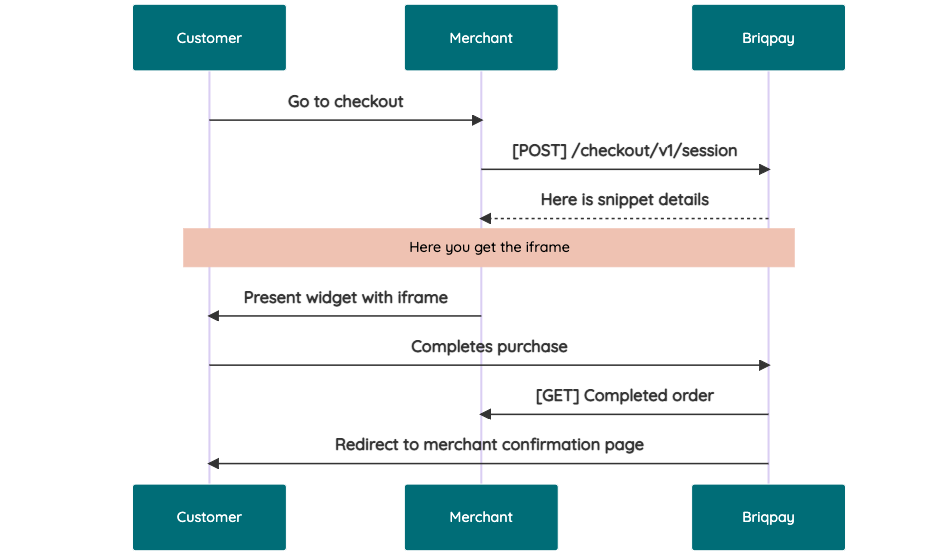 # JavaScript SDK The first step of integration is to add our JS to your site just before closing the ```` tag. This ensures that our JS library is avaliable to load the checkout. ```` Briqpay offers a few methods avaliable through our Javascript SDK. The library is added by our iframe and is avalable on ``window._briqpay`` If you offer the posibility to update the cart or order amonts on the checkout page, the JS library will help you. If your store charges the customer different costs and fees depening on their shipping location, you can listen to the ``addressupdate``event in order to re-calculate the total cost. ```javascript window._briqpay.subscribe('addressupdate', function (data) { console.log(data) }) ``` If your frontend needs to perform an action whe the signup has completed, listen to the ``signup_finalized`` event. ```javascript window._briqpay.subscribe('signup_finalized', function (status) { // redirect or handle status 'success' / 'failure' }) ``` If you allow customers to change the total cart value, you can utilise the JS library to suspend the iframe while you perform a backen update call towards our services. As described below: 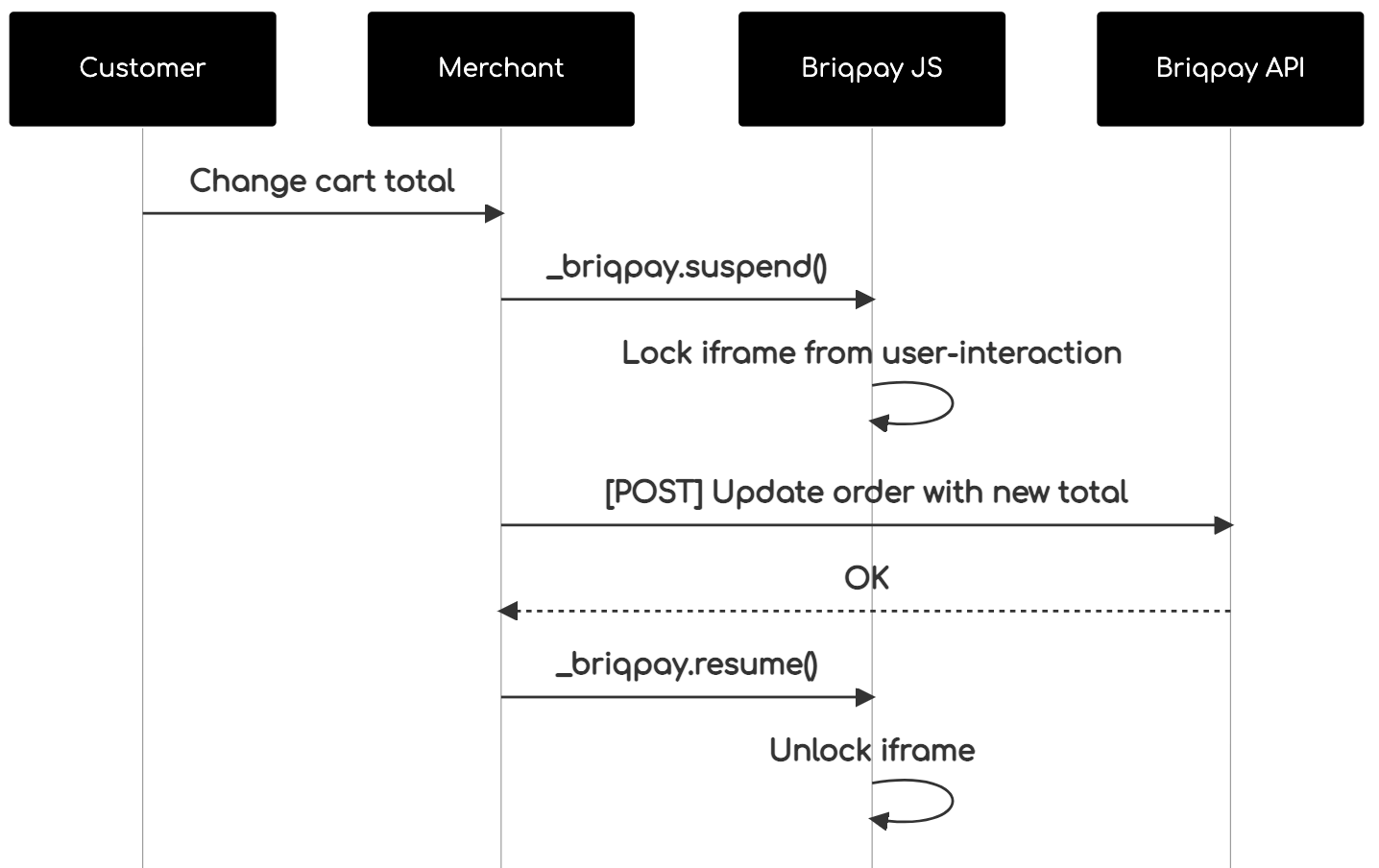 The iframe will auto-resume after 7 seconds if you dont call ``_briqpay.resume()`` before # Test Data In order to verify your integration you will neeed to use test data towards our credit engine. ## Company identication numbers * 1111111111 - To recieve a high credit scoring company ( 100 in rating) * 2222222222 - To test the enviournment with a bad credit scoring company (10 in rating) ## Card details In our playground setup your account is by default setup with a Stripe integration. In order to test out the card form you can use the below card numbers: * 4000002500003155 - To mock 3ds authentication window * 4000000000000069 Charge is declined with an expired_card code. You can use any valid expiry and CVC code # Authentication Briqpay utilizes JWT in order to authenticate calls to our platform. Authentication tokens expire after 48 hours, and at that point you can generate a new token for the given resource using the ``/auth`` endpoint. - Basic Auth - only used on the auth endpoint in order to get the Bearer Token - JWT Bearer Token - All calls towards the API utlizes this method"
andriichuk/laravel-http-client-logger
101 Downloads
Configurable request/response logger for Laravel HTTP client with sanitization and status filters
andrewdyer/actions
186 Downloads
A framework-agnostic library for building structured and predictable JSON responses with standardised response handling
ahmedhat/unifonicnextgen
3481 Downloads
## Introduction Send SMS messages using Unifonic Messaging API. Get your dedicated Universal number, and start sending messages today. Unifonic NextGen Restful and HTTP **API's** uses The basic Authentication protocol. All request and response bodies are formatted in JSON. ## Get an account To start using the API you need to send an email to Unifonic to create Appsid for you. ## Base URL All URLs referenced in the documentation have the following base: **basic.unifonic.com** ## Security To ensure privacy we recommend you to use HTTPS for all Unifonic API requests. you can download our HTTPS certificate. [Download] (https://api.unifonic.com/udm/https.zip) ## Formats Unifonic API only supports JSON format. All request must use the Content-type header set to application/json. ## Support We’re here to help! Get in touch with support at and we’ll get back to you as soon as we can or you can contact us throw live chat on our [website] (www.unifonic.com).