Libraries tagged by http methods
inda-hr/php_sdk
1421 Downloads
# Introduction **INDA (INtelligent Data Analysis)** is an [Intervieweb](https://www.intervieweb.it/hrm/) AI solution provided as a RESTful API. The INDA pricing model is *credits-based*, which means that a certain number of credits is associated to each API request. Hence, users have to purchase a certain amount of credits (established according to their needs) which will be reduced at each API call. INDA accepts and processes a user's request only if their credits quota is grater than - or, at least, equal to - the number of credits required by that request. To obtain further details on the pricing, please visit our [site](https://inda.ai) or contact us. INDA HR embraces a wide range of functionalities to manage the main elements of a recruitment process: + [**candidate**](https://api.inda.ai/hr/docs/v2/#tag/Resume-Management) (hereafter also referred to as **resume** or **applicant**), or rather a person looking for a job; + [**job advertisement**](https://api.inda.ai/hr/docs/v2/#tag/JobAd-Management) (hereafter also referred to as **job ad**), which is a document that collects all the main information and details about a job vacancy; + [**application**](https://api.inda.ai/hr/docs/v2/#tag/Application-Management), that binds candidates to job ads; it is generated whenever a candidate applies for a job. Each of them has a specific set of methods that grants users the ability to create, read, update and delete the relative documents, plus some special features based on AI approaches (such as *document parsing* or *semantic search*). They can be explored in their respective sections. Data about the listed document types can be enriched by connecting them to other INDA supported entities, such as [**companies**](https://api.inda.ai/hr/docs/v2/#tag/Company-Management) and [**universities**](https://api.inda.ai/hr/docs/v2/#tag/Universities), so that recruiters may get a better and more detailed idea on the candidates' experiences and acquired skills. All the functionalities mentioned above are meant to help recruiters during the talent acquisition process, by exploiting the power of AI systems. Among the advantages a recruiter has by using this kind of systems, tackling the bias problem is surely one of the most relevant. Bias in recruitment is a serious issue that affect both recruiters and candidates, since it may cause wrong hiring decisions. As we care a lot about this problem, we are constantly working on reduce the bias in original data so that INDA results may be as fair as possible. As of now, in order to tackle the bias issue, INDA automatically ignores specific fields (such as name, gender, age and nationality) during the initial processing of each candidate data. Furthermore, we decided to let users collect data of various types, including personal or sensitive details, but we do not allow their usage if it is different from statistical purposes; our aim is to discourage recruiters from focusing on candidates' personal information, and to put their attention on the candidate's skills and abilities. We want to help recruiters to prevent any kind of bias while searching for the most valuable candidates they really need. The following documentation is addressed both to developers, in order to provide all technical details for INDA integration, and to managers, to guide them in the exploration of the implementation possibilities. The host of the API is [https://api.inda.ai/hr/v2/](https://api.inda.ai/hr/v2/). We recommend to check the API version and build (displayed near the documentation title). You can contact us at [email protected] in case of problems, suggestions, or particular needs. The search panel on the left can be used to navigate through the documentation and provides an overview of the API structure. On the right, you can find (*i*) the url of the method, (*ii*) an example of request body (if present), and (*iii*) an example of response for each response code. Finally, in the central section of each API method, you can find (*i*) a general description of the purpose of the method, (*ii*) details on parameters and request body schema (if present), and (*iii*) details on response schema, error models, and error codes.
makeroi/name-case-lib
768 Downloads
Created based on the NameCaseLib library (https://github.com/seagullua/NameCaseLib). NameCaseLib is a PHP library designed for automatic declension of full names in Russian and Ukrainian. A unique feature is that the librarycontains the same methods for working with full names in Russian and Ukrainian.
briqpay/php-sdk
12167 Downloads
This is the API documentation for Briqpay. You can find out more about us and our offering at our website [https://briqpay.com](https://briqpay.com) In order to get credentials to the playgrund API Please register at [https://app.briqpay.com](https://app.briqpay.com) # Introduction Briqpay Checkout is an inline checkout solution for your b2b ecommerce. Briqpay Checkout gives you the flexibility of controlling your payment methods and credit rules while optimizing the UX for your customers # SDKs Briqpay offers standard SDKs to PHP and .NET based on these swagger definitions. You can download them respively or use our swagger defintitions to codegen your own versions. #### For .NET `` Install-Package Briqpay `` #### For PHP `` composer require briqpay/php-sdk `` # Standard use-case As a first step of integration you will need to create a checkout session. \n\nIn this session you provide Briqpay with the basic information necessary. In the response from briqpay you will recieve a htmlsnippet that is to be inserted into your frontend. The snippet provided by briqpay will render an iframe where the user will complete the purchase. Once completed, briqpay will redirect the customer to a confirmation page that you have defined. 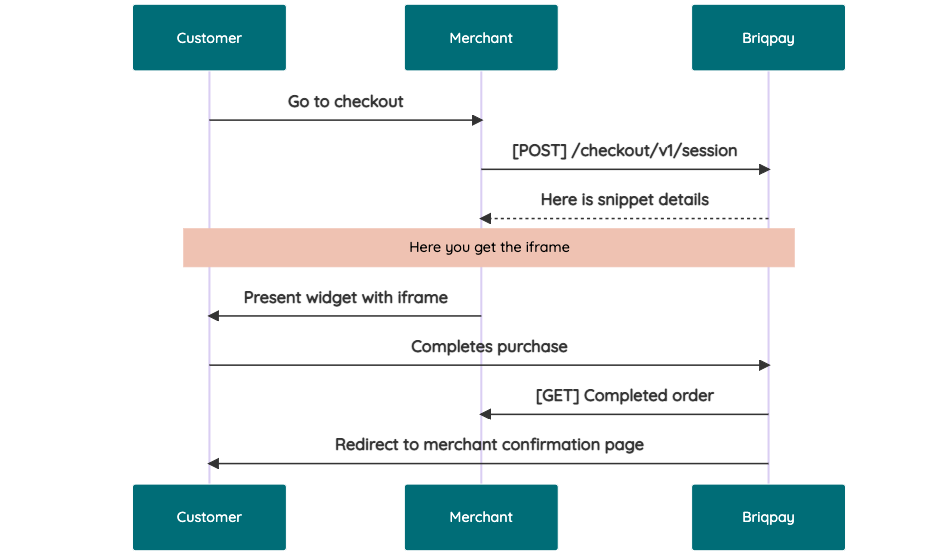 # JavaScript SDK The first step of integration is to add our JS to your site just before closing the ```` tag. This ensures that our JS library is avaliable to load the checkout. ```` Briqpay offers a few methods avaliable through our Javascript SDK. The library is added by our iframe and is avalable on ``window._briqpay`` If you offer the posibility to update the cart or order amonts on the checkout page, the JS library will help you. If your store charges the customer different costs and fees depening on their shipping location, you can listen to the ``addressupdate``event in order to re-calculate the total cost. ```javascript window._briqpay.subscribe('addressupdate', function (data) { console.log(data) }) ``` If your frontend needs to perform an action whe the signup has completed, listen to the ``signup_finalized`` event. ```javascript window._briqpay.subscribe('signup_finalized', function (status) { // redirect or handle status 'success' / 'failure' }) ``` If you allow customers to change the total cart value, you can utilise the JS library to suspend the iframe while you perform a backen update call towards our services. As described below: 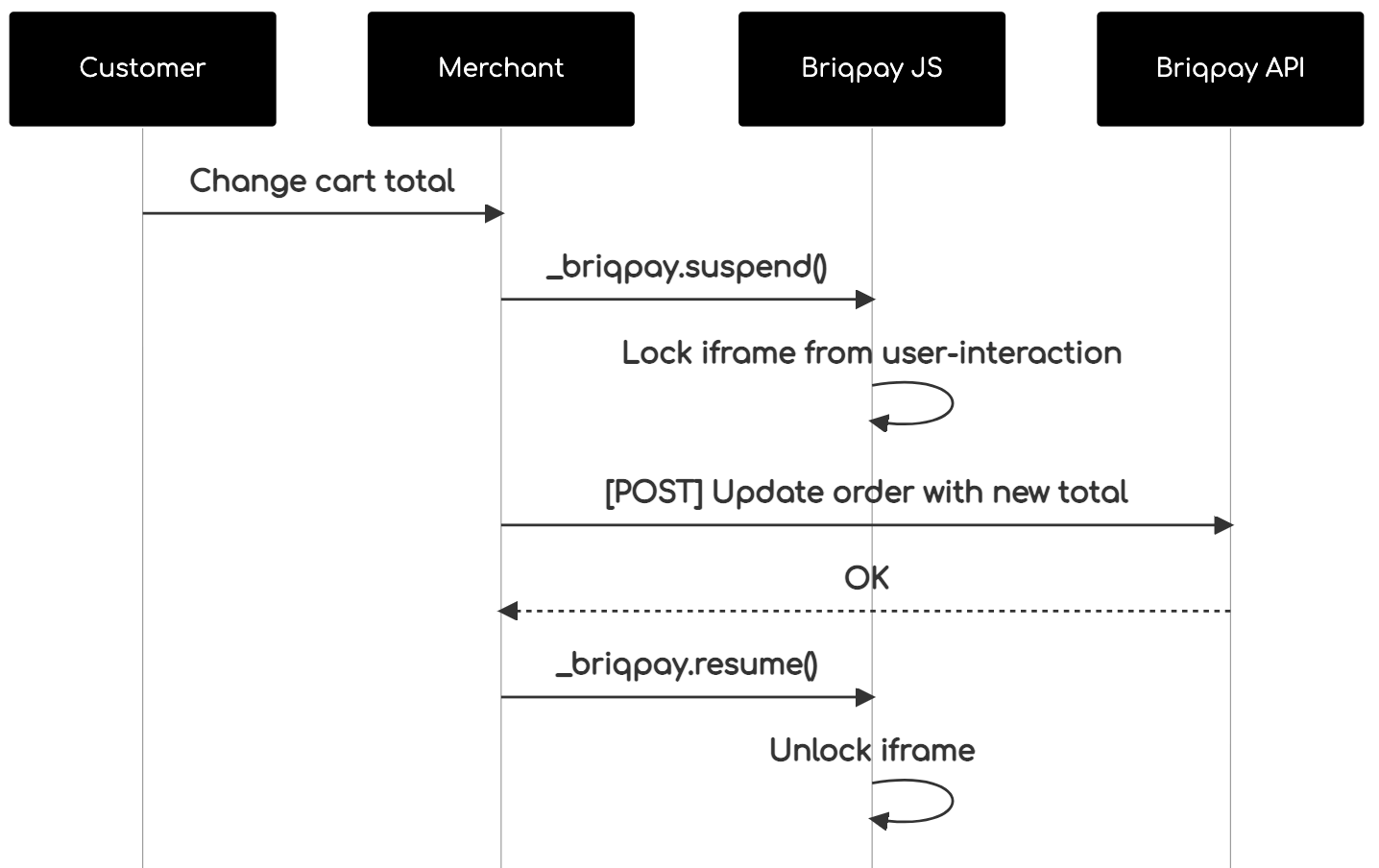 The iframe will auto-resume after 7 seconds if you dont call ``_briqpay.resume()`` before # Test Data In order to verify your integration you will neeed to use test data towards our credit engine. ## Company identication numbers * 1111111111 - To recieve a high credit scoring company ( 100 in rating) * 2222222222 - To test the enviournment with a bad credit scoring company (10 in rating) ## Card details In our playground setup your account is by default setup with a Stripe integration. In order to test out the card form you can use the below card numbers: * 4000002500003155 - To mock 3ds authentication window * 4000000000000069 Charge is declined with an expired_card code. You can use any valid expiry and CVC code # Authentication Briqpay utilizes JWT in order to authenticate calls to our platform. Authentication tokens expire after 48 hours, and at that point you can generate a new token for the given resource using the ``/auth`` endpoint. - Basic Auth - only used on the auth endpoint in order to get the Bearer Token - JWT Bearer Token - All calls towards the API utlizes this method"
firebear/shapeshift
205 Downloads
Add new payment method for https://www.shapeshifth.io
i-kostiuk/time4vps-api
6 Downloads
I have implemented 45% of the methods from the documentation at https://billing.time4vps.com/userapi. I plan to implement all the available functions in the near future. Please support me with your interest if you find this package useful.
factpulse/sdk
76 Downloads
REST API for electronic invoicing in France: Factur-X (CII), UBL 2.1, AFNOR PDP/PA, electronic signatures. ## 🎯 Main Features ### 📄 Invoice Generation - **Formats**: CII XML, UBL 2.1 XML, or Factur-X PDF/A-3 - **Profiles** (CII/PDF): MINIMUM, BASIC, EN16931, EXTENDED - **UBL**: Always EN16931 compliant - **Standards**: EN 16931 (EU directive 2014/55), ISO 19005-3 (PDF/A-3), CII (UN/CEFACT), UBL 2.1 (OASIS) - **Simplified Format**: Generation from SIRET + auto-enrichment (Chorus Pro API + Business Search) ### ✅ Factur-X - Validation - **XML Validation**: Schematron (45 to 210+ rules depending on profile) - **PDF Validation**: PDF/A-3, Factur-X XMP metadata - **VeraPDF**: Strict PDF/A validation (146+ ISO 19005-3 rules) ### ✍️ Electronic Signature - **Standards**: PAdES-B-B, PAdES-B-T (RFC 3161 timestamping), PAdES-B-LT (long-term archival) - **eIDAS Levels**: SES (self-signed), AdES (commercial CA), QES (QTSP) - **Validation**: Cryptographic integrity and certificate verification ### 📋 Flux 6 - Invoice Lifecycle (CDAR) - **CDAR Messages**: Acknowledgements, invoice statuses - **PPF Statuses**: REFUSED (210), PAID (212) ### 📊 Flux 10 - E-Reporting - **Tax Declarations**: International B2B, B2C - **Flow Types**: 10.1 (B2B transactions), 10.2 (B2B payments), 10.3 (B2C transactions), 10.4 (B2C payments) ### 📡 AFNOR PDP/PA (XP Z12-013) - **Flow Service**: Submit and search flows to PDPs - **Directory Service**: Company search (SIREN/SIRET) - **Multi-client**: Support for multiple PDP configs per user ### 🏛️ Chorus Pro - **Public Sector Invoicing**: Complete API for Chorus Pro ### ⏳ Async Tasks - **Celery**: Asynchronous generation, validation and signing - **Polling**: Status tracking via `/tasks/{task_id}/status` - **Webhooks**: Automatic notifications when tasks complete ## 🔒 Authentication All requests require a **JWT token** in the Authorization header: ``` Authorization: Bearer YOUR_JWT_TOKEN ``` ### How to obtain a JWT token? #### 🔑 Method 1: `/api/token/` API (Recommended) **URL:** `https://factpulse.fr/api/token/` This method is **recommended** for integration in your applications and CI/CD workflows. **Prerequisites:** Having set a password on your account **For users registered via email/password:** - You already have a password, use it directly **For users registered via OAuth (Google/GitHub):** - You must first set a password at: https://factpulse.fr/accounts/password/set/ - Once the password is created, you can use the API **Request example:** ```bash curl -X POST https://factpulse.fr/api/token/ \ -H "Content-Type: application/json" \ -d '{ "username": "[email protected]", "password": "your_password" }' ``` **Optional `client_uid` parameter:** To select credentials for a specific client (PA/PDP, Chorus Pro, signing certificates), add `client_uid`: ```bash curl -X POST https://factpulse.fr/api/token/ \ -H "Content-Type: application/json" \ -d '{ "username": "[email protected]", "password": "your_password", "client_uid": "550e8400-e29b-41d4-a716-446655440000" }' ``` The `client_uid` will be included in the JWT and allow the API to automatically use: - AFNOR/PDP credentials configured for this client - Chorus Pro credentials configured for this client - Electronic signature certificates configured for this client **Response:** ```json { "access": "eyJ0eXAiOiJKV1QiLCJhbGc...", // Access token (validity: 30 min) "refresh": "eyJ0eXAiOiJKV1QiLCJhbGc..." // Refresh token (validity: 7 days) } ``` **Advantages:** - ✅ Full automation (CI/CD, scripts) - ✅ Programmatic token management - ✅ Refresh token support for automatic access renewal - ✅ Easy integration in any language/tool #### 🖥️ Method 2: Dashboard Generation (Alternative) **URL:** https://factpulse.fr/api/dashboard/ This method is suitable for quick tests or occasional use via the graphical interface. **How it works:** - Log in to the dashboard - Use the "Generate Test Token" or "Generate Production Token" buttons - Works for **all** users (OAuth and email/password), without requiring a password **Token types:** - **Test Token**: 24h validity, 1000 calls/day quota (free) - **Production Token**: 7 days validity, quota based on your plan **Advantages:** - ✅ Quick for API testing - ✅ No password required - ✅ Simple visual interface **Disadvantages:** - ❌ Requires manual action - ❌ No refresh token - ❌ Less suited for automation ### 📚 Full Documentation For more information on authentication and API usage: https://factpulse.fr/documentation-api/
pnikolov/jquery-serialize-object
5356 Downloads
Wrapper of jquery-serialize-object provided from https://github.com/macek/jquery-serialize-object - Adds the method serializeObject to jQuery, to perform complex form serialization into JavaScript objects.
bleumi/payment-sdk-php
5 Downloads
A simple and powerful REST API to integrate Traditional (Credit/Debit Card, Alternative Payment Methods) and Crypto Currency (Bitcoin, Ethereum, Stablecoins) payments into your business or application. ### Getting Started 1. Create an account on [Bleumi](https://account.bleumi.com/signUp/?app=payment) 1. Fill up your [profile](https://account.bleumi.com/account/?app=payment&tab=profile) 1. Complete your KYC by contacting [[email protected]](mailto:[email protected]) 1. Add your preferred payment service providers in the [Bleumi Portal](https://account.bleumi.com/account/?app=payment&tab=gateway) 1. Create your API key on the [Bleumi Integration Settings](https://account.bleumi.com/account/?app=payment&tab=integration) screen ### Authentication Bleumi uses API keys to authenticate requests. You can view and manage your API keys in the [Bleumi Integration Settings](https://account.bleumi.com/account/?app=payment&tab=integration) screen. Authenticated API requests should be made with a `X-Api-Key` header. Your API key should be passed as the value. ### Payment Methods Use the [Bleumi Portal](https://account.bleumi.com/account/?app=payment&tab=gateway) to add your preferred payment service provider (e.g. Stripe, BitPay, Bleumi Pay) and configure the payment methods that buyers would be able to use to make payments.
maggomann/filament-only-icon-display
6581 Downloads
The package provides the `HasOnlyIcon` trait for [Filament Admin Panel v2.x](https://filamentphp.com/docs/2.x/admin/installation). With this trait it is possible to display the table actions buttons only as icon or optionally only as icon including tooltip. The package currently provides the table action buttons (`CreateAction`, `DeleteAction`, `EditAction` and `ViewAction`) that already contain the trait. Own table action buttons can be extended with the `HasOnlyIcon` €trait, so that the methods are then available.
kaibuecking/php-klarna-payments
31 Downloads
The payments API is used to create a session to offer Klarna's payment methods as part of your checkout. As soon as the purchase is completed the order should be read and handled using the [`Order Management API`](https://docs.klarna.com/api/ordermanagement). Read more on [Klarna payments](https://docs.klarna.com/klarna-payments/).
affixapi/api
13 Downloads
The affixapi.com API documentation. # Introduction Affix API is an OAuth 2.1 application that allows developers to access customer data, without developers needing to manage or maintain integrations; or collect login credentials or API keys from users for these third party systems. # OAuth 2.1 Affix API follows the [OAuth 2.1 spec](https://datatracker.ietf.org/doc/html/draft-ietf-oauth-v2-1-08). As an OAuth application, Affix API handles not only both the collection of sensitive user credentials or API keys, but also builds and maintains the integrations with the providers, so you don't have to. # How to obtain an access token in order to get started, you must: - register a `client_id` - direct your user to the sign in flow (`https://connect.affixapi.com` [with the appropriate query parameters](https://github.com/affixapi/starter-kit/tree/master/connect)) - capture `authorization_code` we will send to your redirect URI after the sign in flow is complete and exchange that `authorization_code` for a Bearer token # Sandbox keys (xhr mode) ### dev ``` eyJhbGciOiJFUzI1NiIsImtpZCI6Ims5RmxwSFR1YklmZWNsUU5QRVZzeFcxazFZZ0Zfbk1BWllOSGVuOFQxdGciLCJ0eXAiOiJKV1MifQ.eyJwcm92aWRlciI6InNhbmRib3giLCJzY29wZXMiOlsiLzIwMjMtMDMtMDEveGhyL2NvbXBhbnkiLCIvMjAyMy0wMy0wMS94aHIvZW1wbG95ZWUiLCIvMjAyMy0wMy0wMS94aHIvZW1wbG95ZWVzIiwiLzIwMjMtMDMtMDEveGhyL2dyb3VwcyIsIi8yMDIzLTAzLTAxL3hoci9pZGVudGl0eSIsIi8yMDIzLTAzLTAxL3hoci9wYXlydW5zIiwiLzIwMjMtMDMtMDEveGhyL3BheXJ1bnMvOnBheXJ1bl9pZCIsIi8yMDIzLTAzLTAxL3hoci90aW1lLW9mZi1iYWxhbmNlcyIsIi8yMDIzLTAzLTAxL3hoci90aW1lLW9mZi1lbnRyaWVzIiwiLzIwMjMtMDMtMDEveGhyL3RpbWVzaGVldHMiLCIvMjAyMy0wMy0wMS94aHIvd29yay1sb2NhdGlvbnMiXSwidG9rZW4iOiIzODIzNTNlMi05N2ZiLTRmMWEtOTYxYy0zZDI5OTViNzYxMTUiLCJpYXQiOjE3MTE4MTA3MTQsImlzcyI6InB1YmxpY2FwaS1pbnRlcm1lZGlhdGUuZGV2LmVuZ2luZWVyaW5nLmFmZml4YXBpLmNvbSIsInN1YiI6InhociIsImF1ZCI6IjNGREFFREY5LTFEQ0E0RjU0LTg3OTQ5RjZBLTQxMDI3NjQzIn0.zUJPaT6IxcIdr8b9iO6u-Rr5I-ohTHPYTrQGrgOFghbEbovItiwr9Wk479GnJVJc3WR8bxAwUMAE4Ul6Okdk6Q ``` #### `employees` endpoint sample: ``` curl --fail \ -X GET \ -H 'Authorization: Bearer eyJhbGciOiJFUzI1NiIsImtpZCI6Ims5RmxwSFR1YklmZWNsUU5QRVZzeFcxazFZZ0Zfbk1BWllOSGVuOFQxdGciLCJ0eXAiOiJKV1MifQ.eyJwcm92aWRlciI6InNhbmRib3giLCJzY29wZXMiOlsiLzIwMjMtMDMtMDEveGhyL2NvbXBhbnkiLCIvMjAyMy0wMy0wMS94aHIvZW1wbG95ZWUiLCIvMjAyMy0wMy0wMS94aHIvZW1wbG95ZWVzIiwiLzIwMjMtMDMtMDEveGhyL2dyb3VwcyIsIi8yMDIzLTAzLTAxL3hoci9pZGVudGl0eSIsIi8yMDIzLTAzLTAxL3hoci9wYXlydW5zIiwiLzIwMjMtMDMtMDEveGhyL3BheXJ1bnMvOnBheXJ1bl9pZCIsIi8yMDIzLTAzLTAxL3hoci90aW1lLW9mZi1iYWxhbmNlcyIsIi8yMDIzLTAzLTAxL3hoci90aW1lLW9mZi1lbnRyaWVzIiwiLzIwMjMtMDMtMDEveGhyL3RpbWVzaGVldHMiLCIvMjAyMy0wMy0wMS94aHIvd29yay1sb2NhdGlvbnMiXSwidG9rZW4iOiIzODIzNTNlMi05N2ZiLTRmMWEtOTYxYy0zZDI5OTViNzYxMTUiLCJpYXQiOjE3MTE4MTA3MTQsImlzcyI6InB1YmxpY2FwaS1pbnRlcm1lZGlhdGUuZGV2LmVuZ2luZWVyaW5nLmFmZml4YXBpLmNvbSIsInN1YiI6InhociIsImF1ZCI6IjNGREFFREY5LTFEQ0E0RjU0LTg3OTQ5RjZBLTQxMDI3NjQzIn0.zUJPaT6IxcIdr8b9iO6u-Rr5I-ohTHPYTrQGrgOFghbEbovItiwr9Wk479GnJVJc3WR8bxAwUMAE4Ul6Okdk6Q' \ 'https://dev.api.affixapi.com/2023-03-01/xhr/employees' ``` ### prod ``` eyJhbGciOiJFUzI1NiIsImtpZCI6Ims5RmxwSFR1YklmZWNsUU5QRVZzeFcxazFZZ0Zfbk1BWllOSGVuOFQxdGciLCJ0eXAiOiJKV1MifQ.eyJwcm92aWRlciI6InNhbmRib3giLCJzY29wZXMiOlsiLzIwMjMtMDMtMDEveGhyL2NvbXBhbnkiLCIvMjAyMy0wMy0wMS94aHIvZW1wbG95ZWUiLCIvMjAyMy0wMy0wMS94aHIvZW1wbG95ZWVzIiwiLzIwMjMtMDMtMDEveGhyL2dyb3VwcyIsIi8yMDIzLTAzLTAxL3hoci9pZGVudGl0eSIsIi8yMDIzLTAzLTAxL3hoci9wYXlydW5zIiwiLzIwMjMtMDMtMDEveGhyL3BheXJ1bnMvOnBheXJ1bl9pZCIsIi8yMDIzLTAzLTAxL3hoci90aW1lLW9mZi1iYWxhbmNlcyIsIi8yMDIzLTAzLTAxL3hoci90aW1lLW9mZi1lbnRyaWVzIiwiLzIwMjMtMDMtMDEveGhyL3RpbWVzaGVldHMiLCIvMjAyMy0wMy0wMS94aHIvd29yay1sb2NhdGlvbnMiXSwidG9rZW4iOiIzYjg4MDc2NC1kMGFmLTQ5ZDAtOGM5OS00YzIwYjE2MTJjOTMiLCJpYXQiOjE3MTE4MTA4NTgsImlzcyI6InB1YmxpY2FwaS1pbnRlcm1lZGlhdGUucHJvZC5lbmdpbmVlcmluZy5hZmZpeGFwaS5jb20iLCJzdWIiOiJ4aHIiLCJhdWQiOiIwOEJCMDgxRS1EOUFCNEQxNC04REY5OTIzMy02NjYxNUNFOSJ9.n3pJmmfegU21Tko_TyUyCHi4ITvfd75T8NFFTHmf1r8AI8yCUYTWdfNjyZZWcZD6z50I3Wsk2rAd8GDWXn4vlg ``` #### `employees` endpoint sample: ``` curl --fail \ -X GET \ -H 'Authorization: Bearer eyJhbGciOiJFUzI1NiIsImtpZCI6Ims5RmxwSFR1YklmZWNsUU5QRVZzeFcxazFZZ0Zfbk1BWllOSGVuOFQxdGciLCJ0eXAiOiJKV1MifQ.eyJwcm92aWRlciI6InNhbmRib3giLCJzY29wZXMiOlsiLzIwMjMtMDMtMDEveGhyL2NvbXBhbnkiLCIvMjAyMy0wMy0wMS94aHIvZW1wbG95ZWUiLCIvMjAyMy0wMy0wMS94aHIvZW1wbG95ZWVzIiwiLzIwMjMtMDMtMDEveGhyL2dyb3VwcyIsIi8yMDIzLTAzLTAxL3hoci9pZGVudGl0eSIsIi8yMDIzLTAzLTAxL3hoci9wYXlydW5zIiwiLzIwMjMtMDMtMDEveGhyL3BheXJ1bnMvOnBheXJ1bl9pZCIsIi8yMDIzLTAzLTAxL3hoci90aW1lLW9mZi1iYWxhbmNlcyIsIi8yMDIzLTAzLTAxL3hoci90aW1lLW9mZi1lbnRyaWVzIiwiLzIwMjMtMDMtMDEveGhyL3RpbWVzaGVldHMiLCIvMjAyMy0wMy0wMS94aHIvd29yay1sb2NhdGlvbnMiXSwidG9rZW4iOiIzYjg4MDc2NC1kMGFmLTQ5ZDAtOGM5OS00YzIwYjE2MTJjOTMiLCJpYXQiOjE3MTE4MTA4NTgsImlzcyI6InB1YmxpY2FwaS1pbnRlcm1lZGlhdGUucHJvZC5lbmdpbmVlcmluZy5hZmZpeGFwaS5jb20iLCJzdWIiOiJ4aHIiLCJhdWQiOiIwOEJCMDgxRS1EOUFCNEQxNC04REY5OTIzMy02NjYxNUNFOSJ9.n3pJmmfegU21Tko_TyUyCHi4ITvfd75T8NFFTHmf1r8AI8yCUYTWdfNjyZZWcZD6z50I3Wsk2rAd8GDWXn4vlg' \ 'https://api.affixapi.com/2023-03-01/xhr/employees' ``` # Compression We support `brotli`, `gzip`, and `deflate` compression algorithms. To enable, pass the `Accept-Encoding` header with one or all of the values: `br`, `gzip`, `deflate`, or `identity` (no compression) In the response, you will receive the `Content-Encoding` response header indicating the compression algorithm used in the data payload to enable you to decompress the result. If the `Accept-Encoding: identity` header was passed, no `Content-Encoding` response header is sent back, as no compression algorithm was used. # Webhooks An exciting feature for HR/Payroll modes are webhooks. If enabled, your `webhook_uri` is set on your `client_id` for the respective environment: `dev | prod` Webhooks are configured to make live requests to the underlying integration 1x/hr, and if a difference is detected since the last request, we will send a request to your `webhook_uri` with this shape: ``` { added: [ { ..., date_of_birth: '2010-08-06', display_full_name: 'Daija Rogahn', employee_number: '57993', employment_status: 'pending', employment_type: 'other', employments: [ { currency: 'eur', effective_date: '2022-02-25', employment_type: 'other', job_title: 'Dynamic Implementation Manager', pay_frequency: 'semimonthly', pay_period: 'YEAR', pay_rate: 96000, }, ], first_name: 'Daija', ... } ], removed: [], updated: [ { ..., date_of_birth: '2009-11-09', display_full_name: 'Lourdes Stiedemann', employee_number: '63189', employment_status: 'leave', employment_type: 'full_time', employments: [ { currency: 'gbp', effective_date: '2023-01-16', employment_type: 'full_time', job_title: 'Forward Brand Planner', pay_frequency: 'semimonthly', pay_period: 'YEAR', pay_rate: 86000, }, ], first_name: 'Lourdes', } ] } ``` the following headers will be sent with webhook requests: ``` x-affix-api-signature: ab8474e609db95d5df3adc39ea3add7a7544bd215c5c520a30a650ae93a2fba7 x-affix-api-origin: webhooks-employees-webhook user-agent: affixapi.com ``` Before trusting the payload, you should sign the payload and verify the signature matches the signature sent by the `affixapi.com` service. This secures that the data sent to your `webhook_uri` is from the `affixapi.com` server. The signature is created by combining the signing secret (your `client_secret`) with the body of the request sent using a standard HMAC-SHA256 keyed hash. The signature can be created via: - create an `HMAC` with your `client_secret` - update the `HMAC` with the payload - get the hex digest -> this is the signature Sample `typescript` code that follows this recipe: ``` import { createHmac } from 'crypto'; export const computeSignature = ({ str, signingSecret, }: { signingSecret: string; str: string; }): string => { const hmac = createHmac('sha256', signingSecret); hmac.update(str); const signature = hmac.digest('hex'); return signature; }; ``` While verifying the Affix API signature header should be your primary method of confirming validity, you can also whitelist our outbound webhook static IP addresses. ``` dev: - 52.210.169.82 - 52.210.38.77 - 3.248.135.204 prod: - 52.51.160.102 - 54.220.83.244 - 3.254.213.171 ``` ## Rate limits Open endpoints (not gated by an API key) (applied at endpoint level): - 15 requests every 1 minute (by IP address) - 25 requests every 5 minutes (by IP address) Gated endpoints (require an API key) (applied at endpoint level): - 40 requests every 1 minute (by IP address) - 40 requests every 5 minutes (by `client_id`) Things to keep in mind: - Open endpoints (not gated by an API key) will likely be called by your users, not you, so rate limits generally would not apply to you. - As a developer, rate limits are applied at the endpoint granularity. - For example, say the rate limits below are 10 requests per minute by ip. from that same ip, within 1 minute, you get: - 10 requests per minute on `/orders`, - another 10 requests per minute on `/items`, - and another 10 requests per minute on `/identity`, - for a total of 30 requests per minute.
getpop/migrate-loosecontracts
140 Downloads
(Temporary package) Migrate code to package https://github.com/getpop/loosecontracts. Target package description: Loose Contracts: a method to "code against interfaces, not implementations" for strings such as option names, hook names, etc